
Complete Guide to Tummy Tuck
Abdominoplasty is one of the most requested body-contouring procedures among our Australian and New Zealand patients. This guide explains what it corrects, how it is performed, and what recovery genuinely involves — written with the same candour we bring to every consultation.
Med Sanctuary · Surgical Journeys
The Complete Guide to the Tummy Tuck

Tummy Tuck Introduction
Abdominoplasty is one of the most requested body-contouring procedures among our Australian and New Zealand patients. This guide explains what it corrects, how it is performed, and what recovery genuinely involves — written with the same candour we bring to every consultation.
Written by Med Sanctuary · Bangkok
Introduction
A procedure, not a shortcut.
A tummy tuck — clinically, an abdominoplasty — is a surgical procedure that removes excess skin and fat from the lower abdomen and, where needed, repairs the abdominal muscles beneath. It is frequently sought after pregnancy or significant weight loss, when diet and exercise can no longer resolve what has changed structurally.
It is important to be clear from the outset: this is not a weight-loss method, and it is not a substitute for one. The best outcomes belong to patients at or near a stable, healthy weight who want to address skin and muscle that will not respond to anything else. Below, we walk through the procedure the way we would in person — honestly, and in full.
Part One
What a tummy tuck addresses.
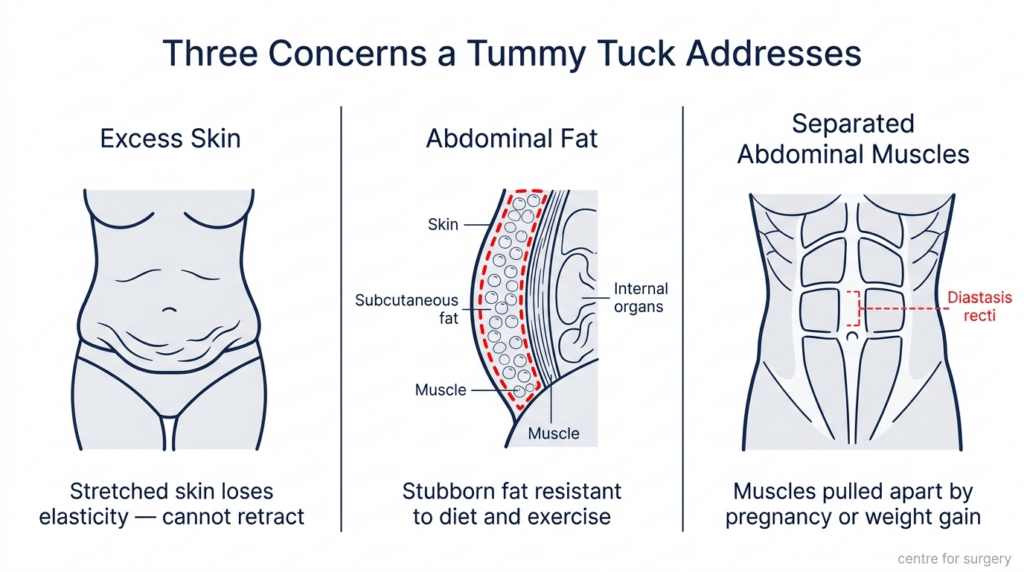
Three distinct concerns sit behind most requests for the procedure. Understanding which ones apply to you is the first step in deciding whether abdominoplasty is the right path.
The three structural concerns abdominoplasty is designed to correct.
Excess skin
After pregnancy or major weight change, stretched skin loses its elasticity and can no longer retract on its own. No amount of training will restore tone to skin that has passed that threshold — only excision will.
Stubborn abdominal fat
A layer of subcutaneous fat that sits resistant to diet and exercise can be addressed during the procedure, often refined further with liposuction of the surrounding zones.
Separated abdominal muscles
Known as diastasis recti, this is the separation of the abdominal muscles — commonly caused by pregnancy or weight gain — that produces a persistent bulge no core work can flatten. A tummy tuck repairs this internal architecture directly, which is what sets it apart from a purely cosmetic skin removal.
Part Two
The types of tummy tuck.
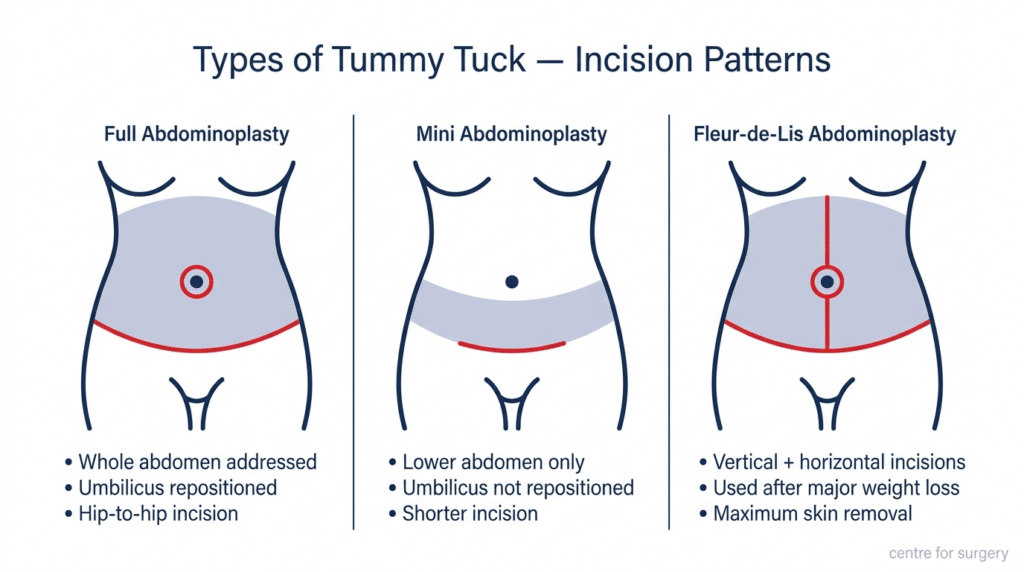
Types of Tummy Tuck
There is no single tummy tuck. The right approach depends on how much skin needs removing and where the laxity sits. Your surgeon selects the incision pattern that achieves the result with the least scarring possible for your anatomy.
The three principal incision patterns, matched to the extent of correction required.
Full abdominoplasty
Addresses the whole abdomen, above and below the navel
The umbilicus is repositioned as the skin is redraped
Uses a hip-to-hip incision, concealed below the underwear line
Mini abdominoplasty
Treats the lower abdomen only — below the navel
The umbilicus is not repositioned
Requires a shorter incision, suited to limited lower laxity
Fleur-de-lis abdominoplasty
Combines a vertical and a horizontal incision
Used most often after major weight loss
Allows maximum skin removal in both directions
Part Three
How the procedure is performed.
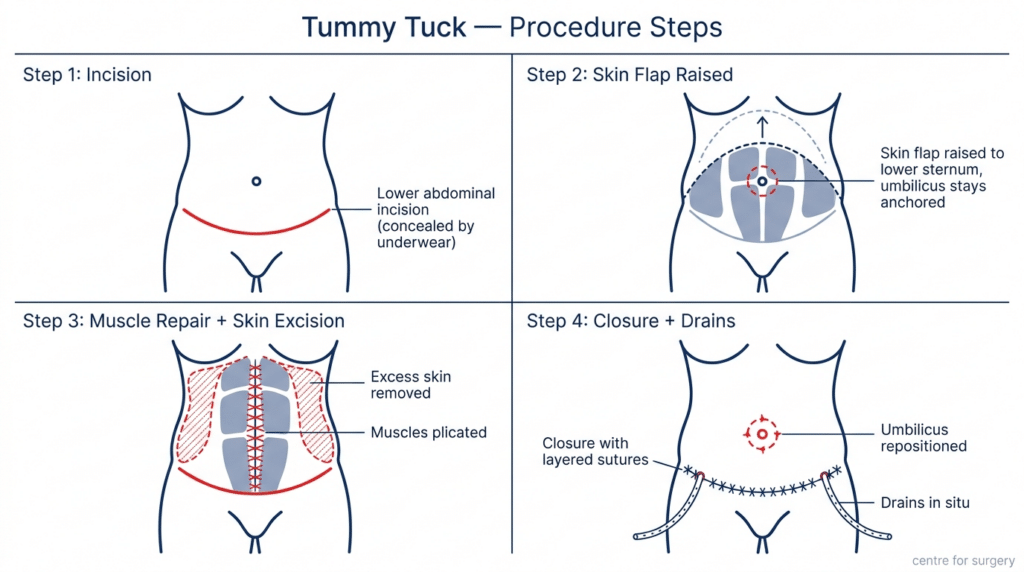
Procedures of Tummy Tuck
Knowing the sequence of a surgery removes much of the fear around it. A full abdominoplasty follows four clear stages, performed under general anaesthetic.
The four operative stages of a full abdominoplasty.
Step 1 — Incision
A lower abdominal incision is made along a line that will sit concealed beneath underwear.
Step 2 — Skin flap raised
The skin is carefully lifted up towards the lower sternum, while the navel stays anchored in its original position.
Step 3 — Muscle repair & skin excision
The separated muscles are stitched back together — plicated — to rebuild a firm abdominal wall, and the excess skin is removed.
Step 4 — Closure & drains
The incision is closed with layered sutures, the navel is brought through to its repositioned site, and temporary drains are placed to prevent fluid collecting as you heal.
The surgery is a single day. The recovery is a season. We plan for both.
Part Four
The recovery timeline.
Recovery from a tummy tuck is longer and more involved than most cosmetic procedures — and we would rather you understood that before you travel than discover it afterwards. The timeline below maps the milestones most patients move through. Individual cases vary.
Seven recovery milestones, from day-case discharge to full scar maturation.
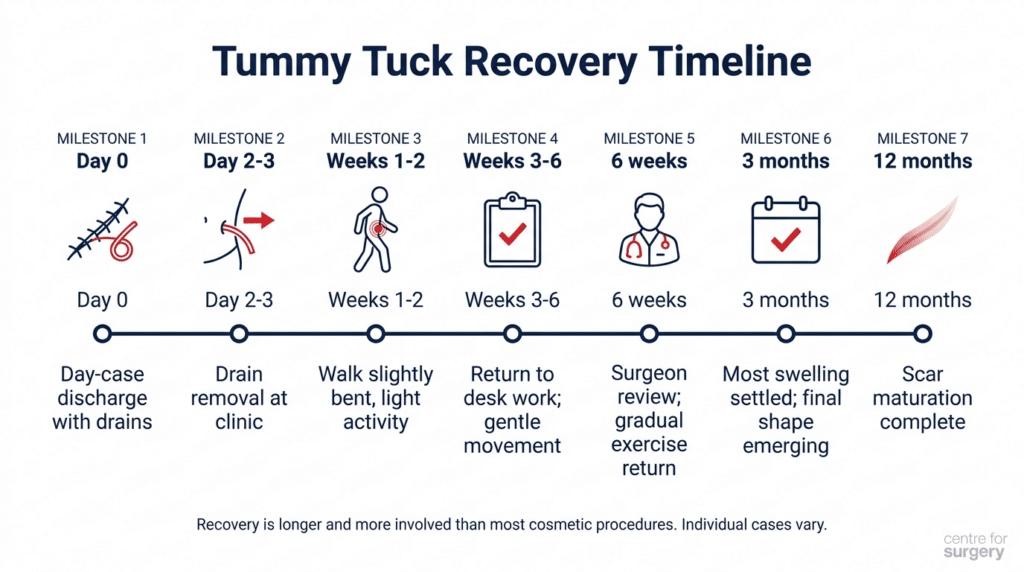
Tummy Tuck Recovery TImeline
Day 0 — Day-case discharge with drains in place.
Day 2–3 — Drain removal at the clinic.
Weeks 1–2 — Walking slightly bent, light activity only.
Weeks 3–6 — Return to desk work and gentle movement.
6 weeks — Surgeon review; gradual return to exercise.
3 months — Most swelling settled; the final shape begins to emerge.
12 months — Scar maturation complete.
Why this matters for travelling patients
For our Australian and New Zealand patients, the early-stage milestones shape how we structure your stay in Bangkok — including the recommended extended recovery period before flying home. We build your journey around this timeline, not against it.
Part Five
Combining procedures.
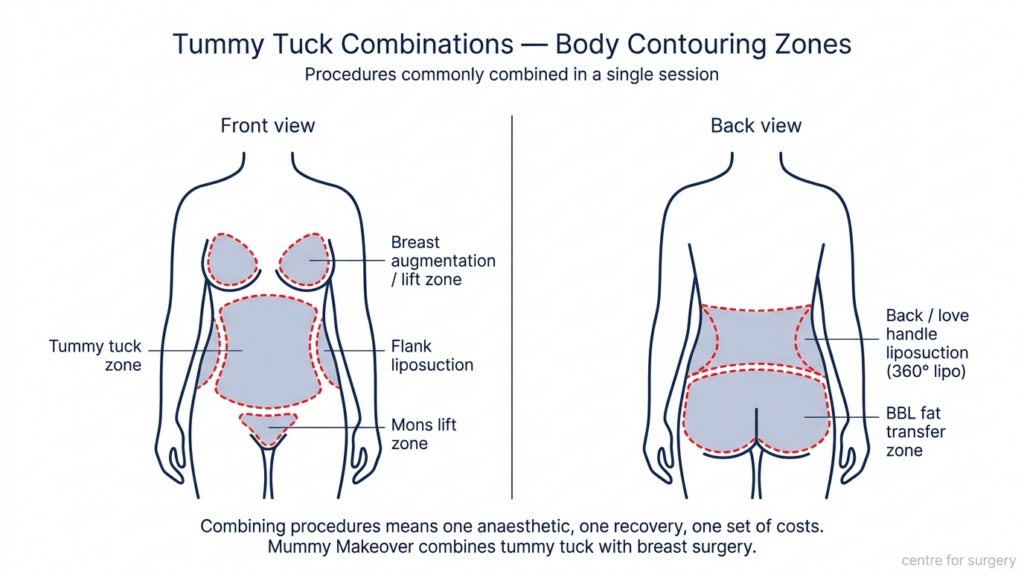
Tummy Tuck Combinations- Body Contouring Zones
A tummy tuck is often performed alongside other body-contouring procedures in a single session. Combining them means one anaesthetic, one recovery, and one set of costs — a meaningful advantage for patients travelling from overseas.
Contouring zones commonly addressed in the same session as abdominoplasty.
Frequently combined zones include flank and 360-degree liposuction, a mons lift, breast augmentation or lift, and fat transfer. When a tummy tuck is paired with breast surgery, the combination is commonly known as a Mummy Makeover — one of our most requested all-inclusive journeys.
Whether combining is right for you depends on your health, the surgeon's assessment, and the total operative time considered safe in one session. This is decided in consultation, never in advance.
In closing
An informed decision is a better one.
A tummy tuck can be genuinely transformative for the right patient — restoring not only contour but the structural integrity of the abdominal wall. It is also real surgery, with a real recovery, and it deserves to be approached with clear eyes. Our role at Med Sanctuary is to give you the full picture, connect you with a board-certified surgeon, and hold the details of your journey so you can focus on healing.
If you are considering abdominoplasty, the next step is a personal assessment — not a sales call. We will review your goals, your medical history, and whether the procedure suits you at all.

Begin with a private consultation
Share your goals and a few photographs, and we will return a candid assessment and an all-inclusive plan tailored to your case.
MED SANCTUARY
Bangkok · Surgical Journeys for Australia & New Zealand
This guide is general educational information and does not constitute medical advice. Surgical suitability, technique, and outcomes vary by individual and can only be determined through consultation with a board-certified surgeon. All procedures carry risk.

