
Facts about Deep Plane Facelift 2026, by Dr.Dominic
The Deep Plane Facelift : A Considered Guide
There is a particular kind of tiredness that no amount of sleep, skincare, or good lighting will fix. It isn't on the surface of the skin — it sits underneath it, in the architecture of the face. When the cheeks begin to slide, the jawline softens into jowls, and the folds beside the mouth deepen, what you are seeing is not a skin problem. It is a structural one. And that is precisely the problem the deep plane facelift was designed to solve.
What it actually is
Beneath the skin of your face lies a continuous sheet of muscle and connective tissue called the SMAS — the superficial musculoaponeurotic system. Think of it as the scaffolding that holds the face up. As we age, this scaffolding loosens and descends, taking the cheeks, jowls, and neck down with it. Gravity does the rest.
A traditional facelift pulls the skin tighter and tightens the SMAS separately. It can look good — but because the skin and the deeper layer are being managed as two different things, the result can sometimes carry that telltale "pulled" tension, especially around the ears, while the heaviness in the midface remains.
The deep plane facelift takes a different route. The surgeon works beneath the SMAS, releasing the small but powerful retaining ligaments that anchor the deeper tissues to the bone. Once those ligaments are released, the skin and the SMAS are lifted and repositioned together, as a single composite unit — gently moved back up to where they once sat, rather than stretched.
Why this matters for the result
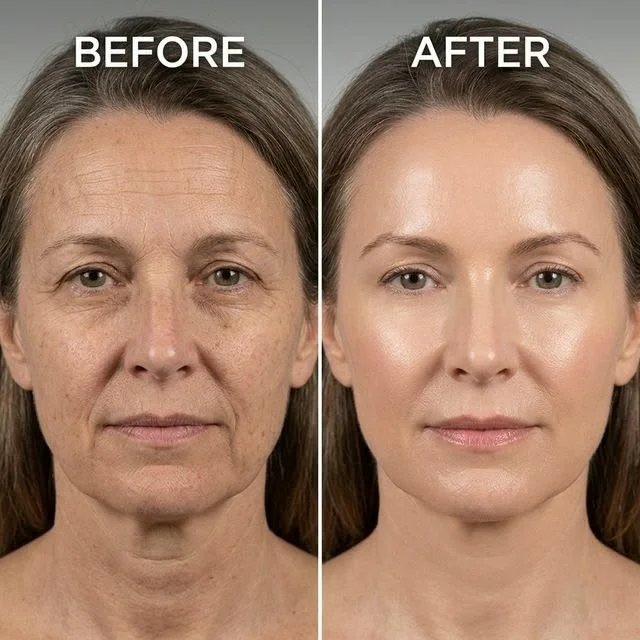
Because the skin is never placed under tension, the deep plane technique tends to produce the outcome most people are actually hoping for: a face that looks rested and natural, not operated on.
It is especially effective in the areas that age the most stubbornly — the midface and cheeks, the folds running from the nose to the mouth, and the jowls along the jawline. Rather than simply tightening the perimeter, it restores volume and definition to the centre of the face, which is where we read youth and vitality. The neck is typically addressed in the same procedure.
The trade-off is honest: the deep plane is more technically demanding than a standard facelift. The dissection takes place in the same plane as the branches of the facial nerve, which means it should only ever be performed by a surgeon with deep anatomical command and significant experience in this specific technique. In skilled hands it is both safe and remarkably effective. This is not a procedure to choose a surgeon for casually — the technique and the surgeon are inseparable.
Who it suits
The deep plane facelift tends to be the right fit for women and men typically in their forties through sixties who are noticing:
Cheeks and midface that have begun to descend
Jowls forming along a once-defined jawline
Deepening folds between the nose and mouth
Loss of a clean angle between the jaw and the neck
A general sense of "heaviness" or downward drift, despite good skin
If your concern is fine surface lines or skin texture alone, a facelift is the wrong tool — that is the domain of resurfacing, energy-based treatments, or injectables. The facelift is for structure. Many people combine it with skin treatments for a complete result, but the lift addresses the foundation.
What to expect
The procedure is performed under anaesthesia and usually takes several hours. Incisions are placed with great care — along the hairline, around the natural contours of the ear, and in the crease behind it — so that once healed they sit hidden and discreet.
A realistic recovery looks roughly like this:
First week: Swelling and bruising peak, then begin to ease. Most sutures come out around day seven. Rest is the priority.
Weeks two to three: The majority of visible bruising resolves. Most people feel comfortable returning to social life and light activity within this window.
Three to six months: Residual swelling continues to settle and the result refines. The face softens into its natural new contour.
Up to a year: Scars mature and fade to fine, pale lines.
Sensation around the ears and cheeks can feel altered for several weeks to months as nerves recover — this is normal and almost always temporary.
An honest word on risk
Every surgery carries risk, and you deserve to hear it plainly. The most common early complication of any facelift is a haematoma — a collection of blood under the skin — which is why the first 24 hours are watched closely. Other risks include infection, temporary or, very rarely, longer-lasting nerve weakness, asymmetry, altered sensation, and the usual considerations that come with anaesthesia. Choosing an experienced, properly accredited surgeon working in an accredited facility is by far the most important thing you can do to keep these risks low.
How long it lasts
A well-performed deep plane facelift doesn't stop you from ageing — nothing does — but it sets the clock back meaningfully, and because the lift is structural rather than skin-deep, the results tend to hold. Many people enjoy ten to fifteen years before they would consider anything further. You continue to age gracefully from a younger starting point.
The right way to think about it
A deep plane facelift is one of the most rewarding procedures in aesthetic surgery when it is done well — and one of the most disappointing when it is not. The difference is almost never the patient. It is the surgeon's skill, the quality of the facility, and the care that surrounds the whole journey, from the first consultation to the final follow-up.
That is exactly the standard we hold ourselves to. Every facelift journey at MedSanctuary is performed by a board-certified plastic surgeon in a fully accredited hospital, with your recovery, your coordination, and your peace of mind looked after from beginning to end.
This guide is for general education and is not a substitute for a personal medical consultation. Suitability for any surgical procedure can only be determined by your surgeon after an individual assessment.

