
When Should I Worry After Surgery? Red Flags by Day
The same symptom means different things on day 2, day 5 and week 6. A surgeon maps the real complication windows after surgery so you know when to worry.
By Dr. Rushapol Sdawat, MD — Thai Board-certified Plastic and Reconstructive Surgeon, Medical Licence No. 17689
Last reviewed:28 AUG 2026
You have read the symptom lists. You know that spreading redness is bad and yellow bruising is fine. But the lists miss the thing experienced surgeons actually use when a patient calls: the date. "My wound is swollen and sore" means one thing on day two, another on day six, and something else entirely in week five — and the response I give depends on the calendar as much as the symptom.
That is the idea this article is built on: complications keep office hours. Each has a window in which it typically appears, because each arises from a different stage of healing. Bleeding is a problem of fresh surgery; infection needs a few days to establish; fluid collections form as drains come out and activity rises; scar problems belong to the months when collagen is remodelling. Learn the windows and you gain two things — the ability to interpret a symptom by when it arrives, and permission to stop scanning for all dangers at all times.
I write this as a Thai Board-certified plastic and reconstructive surgeon with around twenty-six years in practice, and with a particular reader in mind: the Australian or New Zealander who is in a Bangkok hotel for the first window or two, on a plane during another, and home — far from the surgeon — for the rest.
Why does the calendar change what a symptom means?
Because the tissue underneath is doing different work each week. In the first hours and days, the surgical field is raw and its small vessels are freshly sealed — the characteristic danger is bleeding. By day three to five, any bacteria introduced at surgery or through a wound edge have had time to multiply to the point of declaring themselves — the characteristic danger becomes infection. From week two, you are moving more while internal raw surfaces still weep fluid — enter the seroma — and healing wounds are at their mechanically weakest just as you feel well enough to test them. From week four, the drama shifts to the small and slow: expelled sutures and the beginnings of scar behaviour. From month three, almost everything acute is over and the remaining questions are structural — how the scar matures and, after implants, how the capsule behaves.
One grim exception refuses to keep office hours, and I will keep repeating it: venous thromboembolism — clots — can occur at any point in roughly the first six weeks, with the long-haul flight home sitting squarely inside that risk period.
Days 1–2: what belongs to the bleeding window?
This is the haematoma window. A haematoma is bleeding into the surgical site after closure, and it declares itself with a particular signature: swelling that is one-sided, expanding over hours, tight and shiny, disproportionately painful, often with deep bruising that darkens as you watch. It is most common in the first 24–48 hours — a blood-pressure spike, a strain, a burst of activity can all set it off. A significant haematoma is not a wait-and-see problem: unrelieved, it stretches and starves the overlying skin, and the treatment for a large one is a return to theatre to wash it out and stop the bleeding. This is, incidentally, the single best argument for spending the first nights near the operating surgeon rather than flying anywhere: the complication most likely to need the theatre again is front-loaded into the first two days.
Also in this window: fainting on first standing (common — stand slowly, with someone near), nausea from the anaesthetic, and a mild temperature in the first 48 hours, which is usually the lungs re-expanding rather than infection. Fever this early still gets reported — but it is less sinister than the same reading on day five.
Days 3–7: what belongs to the infection window?
Wound infection almost never announces itself on day one; bacteria need time to multiply. It surfaces classically from around day three onward, and its signature is change in the wrong direction after initial improvement: a wound that was settling becomes more painful; redness appears and spreads; the skin around the incision becomes hot; discharge turns thick, yellow-green or offensive-smelling; and fever of 38°C or higher may arrive. Contrast that with normal day 3–7 events — swelling peaking around day three to five, bruising blooming into livid colour, tiredness — all of which look dramatic but trend better each day.
The discipline for this window is the trajectory test, plus a ballpoint pen: trace the edge of any redness and note the time. Redness that retreats from the line is inflammation settling; redness that marches past it is an infection until proven otherwise, and it needs same-day review — in Bangkok that is a message to my team and a wound check at Intrarat Hospital; at home it is your GP today or an emergency department tonight. Early infection caught at the "hot pink patch" stage is usually a course of antibiotics; the same infection a week late can mean an abscess, an opened wound, and a scar we both regret.
Weeks 2–3: why is this the trap window?
Because you feel better than you are, and because for travelling patients it usually contains a nine-hour flight. Three problems own this window:
Seroma — a pocket of straw-coloured fluid accumulating where tissue was lifted, typically after drains are out and activity rises. Signature: soft, sloshy, often painless fullness that shifts with position, sometimes with a palpable fluid wave. Small ones resorb under compression; larger ones need needle drainage, sometimes repeatedly. Annoying and manageable — but left ignored it can become infected or form a stiff shell.
Wound breakdown (dehiscence) — healing wounds are at their weakest around weeks two to three, exactly when patients resume lifting toddlers and luggage. Small edge separations usually heal with dressings; any opening that is deep, widening or weeping needs review now.
Clots — still. A DVT does not care that your wound looks perfect. One-sided calf pain or swelling, or any breathlessness or chest pain, is an emergency in this window just as it was in the first — and the flight home concentrates the risk. The World Health Organization's research found flights of four hours or more roughly double VTE risk; recent surgery multiplies your baseline further. Walk the aisle hourly, hydrate, wear the compression stockings we fit, and treat calf or chest symptoms after any flight as act-now events.
Weeks 4–8: what do the small, slow problems look like?
The acute dangers fade and a quieter cast arrives. Spitting sutures — pimple-like spots on a healed incision, sometimes with a whitish thread emerging — are buried dissolving stitches your body is expelling; common, usually trivial, escalating only if the area becomes increasingly red and hot. Late seromas can still form, particularly after an early return to hard exercise. Numb patches persist and occasionally fizz painfully as nerves regrow. And the scar begins declaring its intentions: every scar is red, raised and firm in these weeks — that is normal maturation, not a bad result — but a scar becoming progressively thicker, wider, itchier and more raised month on month is trending hypertrophic and is worth early treatment (silicone, taping, sometimes injections) rather than a year of hoping.
Month 3 and beyond: what are the late arrivals?
By now, redness that would have meant infection in week one is more likely a suture reaction; swelling that would have meant haematoma on day two is more likely residual oedema or, after breast surgery, something structural. Two late arrivals matter most. Capsular contracture, after any breast implant surgery: the natural capsule around an implant tightens abnormally, and the breast becomes progressively firmer, higher, distorted or uncomfortable over months to years — it is not an emergency, but it is a real complication that sometimes needs revision surgery, and any Australian or New Zealand patient with implants should have a GP or surgeon at home able to assess it. Hypertrophic and keloid scarring declare fully in this period: partly genetic, not fully preventable, and better treated early than late. Scars take twelve to eighteen months to fade to their final pale, flat form — judge nothing before then, including your own decision to have surgery.
The same swelling, five different meanings
Here is the article in one table — a single symptom, new or worsening swelling, read against the calendar:
When it appearsMost likely explanationCharacterUrgencyDay 1–2Haematoma (bleeding) vs normal early oedemaHaematoma: one-sided, expanding hourly, tight, very painful. Oedema: diffuse, symmetric-ish, mildExpanding/tight/painful = emergency review; may need theatreDay 3–7Peak inflammatory swelling; early infection if hot and redPeaks day 3–5 then trends down; infection adds heat, spreading redness, feverTrending down = normal. Hot, red, febrile = same-day reviewWeek 2–3Seroma; dependent oedema after activity or flightSoft, sloshy, positional; often after drains out or the flight homeReview within 1–2 days; drainage if sizeable. One-sided calf swelling = emergencyWeek 4–8Late seroma; residual oedema, worse by eveningFluctuating, activity-relatedRoutine review; escalate only if enlarging or inflamedMonth 3+Residual remodelling; after implants, consider capsular changeSlow, structural, painless firming or shape changeNon-urgent, but book an assessment — do not just watch it for a year
What can the windows not promise you?
Candidly: biology reads no timetables. Haematomas occasionally arrive on day five; infections can smoulder into week three; a first presentation of a clot can be the collapse itself, without a warning calf. The windows describe where each complication is most likely, so you can rank explanations — they are not fences that dangers cannot cross. And they cannot alter the underlying arithmetic: surgery carries irreducible risks — bleeding, infection, seroma, wound breakdown, necrosis, nerve injury, clots, asymmetry, scarring, disappointment — and having it far from home adds a layer of distance to every one of them. ASAPS estimates roughly 15,000 Australians travel overseas for cosmetic surgery each year and that revision is needed in up to 7% of cases. My aim is to be nowhere near that upper bound, but no honest surgeon promises you zero — anywhere, at any price.
When to seek care
At any time point, regardless of the calendar — emergency (000 in Australia, 111 in NZ, cabin crew mid-flight, straight to hospital in Bangkok): breathlessness, chest pain, coughing blood, collapse; one-sided calf pain or swelling; heavy bleeding; a rapidly expanding tight painful swelling; a wound opening widely.
Same-day review: fever of 38°C or higher; spreading or hot redness (the pen-line test); discharge that is thick, increasing or foul-smelling; dusky, purple-black skin near an incision; sudden severe or steadily escalating pain; any deep or widening wound separation.
Within a day or two, with photographs to your team: suspected seroma; small edge separation; a spitting suture; a scar becoming progressively thicker and more raised; after implants, a breast becoming firmer or changing shape.
In Bangkok, my team is the first call at any hour and Intrarat Hospital is the venue. Once home, the order is: be seen locally first — GP today or emergency department now, with your surgical summary in hand and the words "recent surgery overseas and a long-haul flight" said aloud at triage — then tell us in parallel. Australian private insurers generally do not cover complications of overseas surgery, but Medicare and the public hospital system will still treat you; in New Zealand, ACC cover for overseas surgical injury is limited and assessed case by case, so again, let the public system see you first and sort paperwork second.
How do I use the calendar without being ruled by it?
Let it tell you what to watch this week, and what you are allowed to stop watching. In the first two days, respect rest and report expanding swelling. From day three, apply the trajectory test to redness, pain and temperature. In weeks two and three, distrust your own energy, protect the wound from your enthusiasm, and treat the flight home with the seriousness clots deserve. From week four, shift attention to sutures and scars. From month three, think in months, not days. And through all of it, keep the one list that never changes — clots, spreading infection, expanding bleeding — pinned where you can see it. Everything else can usually wait until morning. Those three never can.
Dr. Rushapol Sdawat (known to international patients as Dr. Dominic) is a Thai Board-certified plastic and reconstructive surgeon practising at Intrarat Hospital, Bangkok, Medical Licence No. 17689. He holds Thai Board certification in General Surgery (Phramongkutklao Hospital) and in Plastic and Reconstructive Surgery (Ramathibodi Hospital, Mahidol University), has been a member of ISAPS since 2008 and is an international member of the American Society of Plastic Surgeons. Dr. Rushapol holds Thai specialist certification; he is not registered with Ahpra and does not hold Australian or New Zealand specialist registration. His registration can be verified on the Medical Council of Thailand register at checkmd.tmc.or.th.
This article is provided for general information and education. It is not medical advice and cannot substitute for individual assessment by a qualified practitioner who knows your history. Surgery carries risk, including risk of serious complications and of outcomes that do not meet expectations. Results vary between patients.
How to Verify a Thai Surgeon's Credentials in Ten Minutes
Use the Medical Council of Thailand's free English register to verify any Thai surgeon's licence and board specialty in minutes — then run every step on me.
By Dr. Rushapol Sdawat, MD — Thai Board-certified Plastic and Reconstructive Surgeon, Medical Licence No. 17689
You have a name, a clinic page full of certificates you cannot read, and a quiet suspicion that you are not qualified to judge any of it. You are right that you are not qualified to judge the certificates. You do not need to be. Almost everything that matters here is a matter of public record, in English, free, and checkable from your kitchen table in less time than it takes to make coffee.
What follows is the process I would use if I were checking another surgeon, written so that you can run it on me. I publish my licence number for exactly that reason: a credential you cannot verify is a claim, and a claim is worth nothing.
Set aside ten minutes. Do it before you pay a deposit, not after.
Why a licence number is the only credential that starts as a fact
Anyone can print a certificate. Anyone can list a society. Anyone can describe themselves as a specialist on a website, because a website is not a register.
A medical licence number is different: it is issued by a state body, it is unique, and it can be looked up by the public against a name. If the number and the name do not match, everything else on the page is worthless. If they do match, you have a foundation for the rest of your checks.
So the first question to ask any Thai clinic is not "is your surgeon qualified?" — every clinic answers yes. It is: "What is the operating surgeon's full name, and what is their Medical Council of Thailand licence number?" Ask in writing, in an email you keep. A clinic that will not give you a licence number for the specific doctor who will hold the knife has told you everything you need to know.
Step one: open the Medical Council of Thailand's public register
The Medical Council of Thailand — the body that licenses every doctor in this country — runs a free public verification service at checkmd.tmc.or.th. The English interface is at https://checkmd.tmc.or.th/En/v3, or click "Search in English" from the Thai page.
The Council's own description of it tells you what you are looking at: "This information is disclosed publicly and is official data intended for inspection purposes, aiming to protect the public and benefit society."
There is a second, separate search on the same page for a Temporary License, used by doctors practising here under temporary registration. If your surgeon appears only there, ask why.
Step two: search by name, in English, and read what comes back
The form has three fields:
Name (required)
Surname (required)
The Medical License Number — labelled "(Fill in only if you want to verify)"
Note the order, because it catches people out. You cannot search by licence number alone. You search by name, and the number confirms the match. That is why you need both from the clinic, and why the page warns "Please ensure that spelling is correct." Thai names transliterate into English several defensible ways, so if nothing comes back, try the alternatives before concluding anything. If you still get nothing, the Council answers directly on +66 2 590 1887 and at tmc@tmc.or.th, 8.30am–4.30pm Monday to Friday, Thai time.
One more line on that page matters more than it looks: the register returns "only active physicians who have licensed to practice." A doctor who has been suspended, struck off, or has allowed registration to lapse does not appear as a tidy record with a red flag on it. They simply do not appear. An absent result is not an inconclusive result. Treat it as a stop.
To verify me: search Name Rushapol, Surname Sdawat, and enter licence number 17689.
Step three: check the specialty, not just the licence
A licence means the person may lawfully practise medicine in Thailand. It does not, on its own, mean they are a plastic surgeon. The register returns specialty and certification information alongside the licence status, and that second line is the one you actually care about.
What you are looking for is certification by the Thai Board of Plastic and Reconstructive Surgery. Not "surgery." Not "cosmetic medicine." Not a diploma from a training course. The board certificate in plastic and reconstructive surgery.
If the register shows a licence but no plastic surgery specialty, you are dealing with a doctor performing cosmetic work — which is a different thing, and I explain the difference below.
What Thai Board certification in plastic and reconstructive surgery actually requires
Thai specialist training in plastic surgery is structured around the scope the Medical Council defines for the specialty. The Society of Plastic and Reconstructive Surgeons of Thailand — founded in 1971 — describes that scope as seven areas a trainee must cover: correction of congenital defects, hand surgery, burns, head and neck cancer surgery, facial fractures, microsurgery, and cosmetic and aesthetic surgery.
Read that list again. Cosmetic surgery is one seventh of what a plastic surgeon is trained in. The other six teach you how to close a wound that will not close, how to move tissue with its blood supply intact, how to manage a flap that is failing at 2am, and how to rebuild a face that has been broken. Those are the skills that matter on the day something goes wrong. A doctor trained only in the aesthetic seventh has learned the part that is easy to sell and skipped the part that saves you.
There are two recognised routes into the Thai Board in plastic and reconstructive surgery. One is to complete a general surgery residency and the Thai Board of General Surgery first, then a plastic surgery residency on top of it. The other is direct entry into a plastic surgery residency programme. Both end at the same board examination and the same certificate. [CONFIRM: exact duration in years of each pathway, with the Royal College of Surgeons of Thailand and the Medical Council of Thailand.]
My own route was the first: MD from Siriraj Hospital, Mahidol University; Thai Board of General Surgery at Phramongkutklao Hospital; then Thai Board of Plastic and Reconstructive Surgery at Ramathibodi Hospital, Mahidol University.
What ISAPS and ASPS membership does and does not mean
This is where most clinic pages quietly mislead, and I want to be precise about it, including about my own listings.
I am a member of ISAPS since 2008 — the International Society of Aesthetic Plastic Surgery — and an international member of the American Society of Plastic Surgeons. Both are true, both are checkable, and neither is a certification.
ISAPS is a membership society. Its process requires that an applicant is accepted by the national plastic surgery society where they practise and holds board certification there; ISAPS states that "no other international organization screens its members as thoroughly and extensively as ISAPS does." That screening has genuine value — somebody checked. But ISAPS does not train, examine or certify surgeons. It admits people already certified by somebody else. The same is true of the American Society of Plastic Surgeons for international members: a society, not a board.
So: "ISAPS-certified" and "ASPS-accredited" are not things. Anyone using those phrases about themselves is either careless with language or hoping you will not notice. Treat it as a small but real signal about how that clinic handles facts generally.
CredentialIssued byWhat it actually establishesHow you verify itMedical Licence No. (e.g. 17689)Medical Council of ThailandThe person may lawfully practise medicine in Thailand, and is currently activeFree public register at checkmd.tmc.or.th, searched by nameThai Board of Plastic and Reconstructive SurgeryThai specialty board, via accredited residency and examinationCompleted full specialist training across the seven defined areas of plastic surgery, and passed the board examinationSpecialty field on the same register entryISAPS membershipInternational Society of Aesthetic Plastic SurgeryThe surgeon is board-certified in their own country and accepted by their national society; screened, not examinedISAPS member search on isaps.orgASPS international membershipAmerican Society of Plastic SurgeonsSociety membership for surgeons practising outside the United StatesASPS member directoryFellowships, courses, symposiaIndividual institutions or facultyFocused additional training in a named technique. Real, but not a specialty qualificationAsk for the certificate and the host institution, then contact the institutionHospital accreditation (e.g. ISO 9001:2015)The certifying body named on the certificateA quality management standard held by the facility, not by the surgeonAsk for the certificate number and check it with the certifying body, not the hospital
On that last row, one clarification about where I operate: Intrarat Hospital is ISO 9001:2015 certified. It is not JCI-accredited, and I will not let that be blurred. If a hospital's accreditation matters to you — and it reasonably might — check what it actually holds rather than what the word "international" seems to imply.
What is the difference between a plastic surgeon and a doctor doing cosmetic work?
A plastic surgeon has completed a residency in plastic and reconstructive surgery and passed a board examination in it. A doctor doing cosmetic work is a registered medical practitioner performing cosmetic procedures without that specialist training. Both may be entirely legal. They are not equivalent.
This is not a peculiarity of Thailand. It is precisely why Ahpra introduced an endorsement for cosmetic surgery from 1 July 2023, which it says "will help consumers know who is trained and qualified to perform cosmetic surgery safely." ASAPS has pointed out that "in some countries, surgeon titles aren't protected" — a fair warning that applies in more places than people assume.
The practical test is not the title. It is the training record and the register entry. Ask which board, in which specialty, at which institution, in which year — then check.
What the register cannot tell you
Here is the part that does not help me sell an operation.
Verifying my licence and board certification tells you I completed specialist training and that the state considers me fit to practise. It tells you nothing about my complication rate, nothing about whether I am any good at the specific operation you want, nothing about whether I will be reachable in week four, and nothing about whether you and I will understand each other.
Ahpra says something similar about its own register, and it is honest of them: "searching the register may not be enough to tell you whether they are qualified and experienced in the specific procedure."
No credential removes surgical risk. A board-certified plastic surgeon in an accredited hospital can still give you a haematoma needing return to theatre the same night, a seroma drained for weeks, infection, wound breakdown, tissue necrosis at the edge of a long incision, permanent numbness from nerve injury, a venous thromboembolism, a scar that widens whatever either of us does, visible asymmetry, and a result you are technically fine with and emotionally disappointed by. Credentials shift the odds and improve what happens next. They do not make surgery safe, and any page implying otherwise — including mine — should be read sceptically.
The ten-minute checklist, in order
Get the operating surgeon's full name and licence number in writing, by email, before any payment.
Search that name on checkmd.tmc.or.th/En/v3, licence number in the verification field. Confirm the record is active.
Read the specialty line. Confirm it says plastic and reconstructive surgery, not "surgery" and not a cosmetic diploma.
Check society memberships on the society's own directory — and mentally downgrade any claim phrased as "certified by" a society.
Ask who will assist, who will anaesthetise, and who reviews you on day one, day three and day seven — by name.
Ask the hospital what accreditation it holds, get the certificate number, and verify it with the certifying body.
Ask for the surgeon's complication figures for your operation, and note whether you get a number, a deflection, or a testimonial.
When to seek care
Verification is a pre-operative task, but the reason it matters is post-operative, so know the thresholds before you travel.
Emergency, immediately, by ambulance if needed — in a Bangkok hotel, on the way to the airport, or at home: chest pain, breathlessness, coughing blood, or a hot, swollen, tender calf. That is possible deep vein thrombosis or pulmonary embolism, the complication most likely to kill you. Also: bleeding soaking through dressings, a rapidly swelling and tightening breast or abdomen, fever above 38.5°C with rigors, spreading redness with dusky, blistered or numb skin, or sudden confusion or collapse.
Same-day review, not tomorrow: a wound edge turning grey or black, discharge that has become cloudy, thick or foul-smelling, pain escalating rather than settling after day three, one-sided calf ache, or a temperature climbing steadily over 24 hours.
Back in Australia or New Zealand, go to a public hospital emergency department for anything in the first group. Take your surgeon's name, your licence-number verification, your operation report and your medication list — the treating team will need them, and having them ready is the most useful thing a returning patient can do. Then send the notes to your surgeon. If that surgeon is me, send them at any hour.
Now run all of it on me
Search Rushapol Sdawat, licence 17689, on the Medical Council of Thailand register. Check the specialty line reads plastic and reconstructive surgery. Look me up in the ISAPS directory and note that it says member, not certified — because that is what it is. Ask Intrarat Hospital for its ISO 9001:2015 certificate and verify it with the certifying body. Ask me who assists, who anaesthetises, and who sees you on day three.
If any of it does not check out, do not book. That applies to me exactly as it applies to everyone else. A surgeon who asks you to verify him and then resents being verified was never offering you much.
Dr. Rushapol Sdawat (known to international patients as Dr. Dominic) is a Thai Board-certified plastic and reconstructive surgeon practising at Intrarat Hospital, Bangkok, Medical Licence No. 17689. He holds Thai Board certification in General Surgery (Phramongkutklao Hospital) and in Plastic and Reconstructive Surgery (Ramathibodi Hospital, Mahidol University), has been a member of ISAPS since 2008 and is an international member of the American Society of Plastic Surgeons. Dr. Rushapol holds Thai specialist certification; he is not registered with Ahpra and does not hold Australian or New Zealand specialist registration. His registration can be verified on the Medical Council of Thailand register at checkmd.tmc.or.th.
This article is provided for general information and education. It is not medical advice and cannot substitute for individual assessment by a qualified practitioner who knows your history. Surgery carries risk, including risk of serious complications and of outcomes that do not meet expectations. Results vary between patients.
Is This Normal After Surgery? A Symptom-by-Symptom Guide
A surgeon sorts 25 common post-op symptoms into normal, monitor and act-now tiers — so you know at 2am whether to sleep, keep watching, or get help fast.
By Dr. Rushapol Sdawat, MD — Thai Board-certified Plastic and Reconstructive Surgeon, Medical Licence No. 17689
Last reviewed: 28 AUG 2026
It is 2am, you are five days out from surgery, and you have just noticed something — a new colour, a new lump, a patch of skin that feels wrong — and your mind has already sprinted to the worst explanation. You are in a hotel room in Bangkok, or newly home in Australia, and the question looping in your head is the same one every post-operative patient asks: is this normal, or is this the start of something?
I have been answering that question for around twenty-six years as a Thai Board-certified plastic and reconstructive surgeon, and here is the first thing to hold onto: the overwhelming majority of 2am worries are normal healing wearing a frightening costume. Bodies heal loudly — with colour, swelling, strange sensations and stranger emotions — and nobody warns patients just how loud it gets. The second thing to hold onto: a small number of symptoms are never dismissible, and knowing that short list cold is worth more than any amount of reassurance about the rest.
This page sorts the common post-operative experiences into three honest tiers: normal, monitor, and act now. It is a guide for thinking, not a substitute for contacting your surgical team — when the two conflict, contact the team.
How do the three tiers work?
NORMAL means expected healing: uncomfortable, sometimes ugly, self-resolving. Note it, mention it at your next review, go back to sleep. MONITOR means usually benign but capable of declaring itself as a problem: watch it actively over 24–48 hours, photograph it daily in the same light, and message your surgical team with the pictures — that is what we are for. ACT NOW means the symptom has earned immediate medical attention — same-day urgent review at minimum, and for some, an ambulance — because the dangerous causes of that symptom cannot be excluded from a hotel room or your loungeroom.
One rule overrides every row of the table below: trajectory beats snapshot. Almost everything on the normal list should be slowly improving week on week. Anything getting worse — bigger, redder, hotter, more painful — has left the normal list, whatever it looked like yesterday.
The symptom table: 25 things patients ask me about
SymptomTierWhat it usually isWhat to doBruising changing colour — purple to green to yellowNORMALBlood pigment breaking down; the colour parade is healing, not spreading damageNothing; expect 2–3 weeksBruising that has tracked downwards (e.g. to pubic area or thighs after a tummy tuck)NORMALGravity moving old blood through tissue planesNothing; alarming to look at, harmlessTightness or a "band" sensation across the operated areaNORMALSwelling plus surgical tension; after muscle repair, the repair itselfImproves over weeks; keep to posture adviceItching around the incisionNORMALNerve endings regrowing; healing skinDo not scratch the scar; cool compress over clothing, antihistamine if we agreeLumpy, firm, uneven tissue under the incisionNORMALOrganising internal scar tissue; settles over weeks to monthsMassage only once your surgeon approvesFatigue out of proportion for weeksNORMALThe metabolic cost of healing; anaesthetic after-effects; poor sleepRest, protein, short walks; improves by weeks 3–6Emotional dip, tearfulness or "why did I do this?" around week 2–3NORMALRecognised post-surgical low mood: hormones, fatigue, swelling hiding the resultTalk about it; it lifts. Persisting or deepening low mood: tell your GPOne side more swollen than the otherNORMALBodies are not symmetrical, and neither is swelling or surgical dissectionPhotograph and compare over days; see MONITOR/ACT NOW rows if enlargingNumb patches around the incisionNORMALSmall skin nerves cut during surgery; recovery takes months, occasionally incompleteNote it; protect numb skin from heat packs and sunburnZaps, tingles and electric-shock feelingsNORMALNerves waking up — usually a good signNothingSwelling worse at day 3–5 than day 1NORMALInflammatory swelling peaks days after surgeryElevation, compression as instructedSwelling worse in the evening, better in the morningNORMALGravity and activity; typical for months after body proceduresPace activity; garment onMild temperature up to about 37.8°C in the first 48 hoursMONITOROften the lungs re-expanding after anaesthesia, or ordinary inflammationBreathe deeply, walk, recheck 4-hourly; fever ≥38°C moves this to ACT NOWA stitch "spitting" — pimple-like spot on a healed incision, thread visibleMONITORBuried dissolvable suture being expelled; common, usually trivialKeep clean, no tweezers; team removes fragment; escalate if spreading rednessSmall wound-edge separation (a few millimetres)MONITORMinor dehiscence, often where tension is highest; usually heals with dressingsCover, keep dry, photograph daily, inform team; widening or deep opening = ACT NOWPersistent numbness beyond early monthsMONITORSlow nerve recovery; occasionally permanentRaise at reviews; protect the areaSmall area of blister or darkening skin near the incisionMONITORPressure or circulation stress in the skin edgeSame-day photos to your team; enlarging dusky/black areas = ACT NOWSoft, sloshing fullness appearing after drains outMONITORLikely seroma (fluid pocket)Team review within a day or two; may need needle drainagePinkish thin fluid ooze from incision, small volumeMONITORNormal early wound fluidDressing, photograph; increasing volume, thickness or smell = ACT NOWNausea or poor appetite in week oneMONITORAnaesthetic and opioid after-effectsFluids, small meals, anti-nausea tablets; can't keep fluids down = same-day reviewNo bowel motion by day 3 on opioid painkillersMONITOROpioid constipationLaxatives now, fluids, walk; do not strain, especially after muscle repairCalf pain, tightness or swelling — one legACT NOWPossible deep vein thrombosis (DVT)Same-day emergency assessment; do not massage the legBreathlessness, chest pain, coughing blood, or collapseACT NOWPossible pulmonary embolism — clot on the lungAmbulance / tell cabin crew immediately. This is the emergencyRapidly expanding, tight, painful one-sided swelling (especially first 48 hours)ACT NOWPossible haematoma — internal bleedingUrgent surgical review; may need return to theatreSpreading hot redness around a wound, ± fever ≥38°CACT NOWLikely infection, possibly cellulitisSame-day medical review; needs assessment ± antibioticsWound discharge that is thick, increasing, or smells offensiveACT NOWInfected wound or infected fluid collectionSame-day review; swab, drainage, antibiotics as neededSudden severe pain, out of keeping with your trajectoryACT NOWBleeding, infection, or another complication until proven otherwiseSame-day urgent contact; severe and escalating = emergency department
Why does normal healing look so dramatic?
Because surgery is controlled injury, and the body's repair response is ancient, inflammatory and unsubtle. Blood vessels leak fluid into the tissues — that is swelling, and it peaks days after the operation, which is why day four can look worse than day one. Escaped blood breaks down through purple, green and yellow like a slow firework. Cut nerves fall silent, leaving numb patches, then wake months later with fizzes and zaps. Under the skin, healing tissue is laid down as firm, lumpy collagen before it is slowly remodelled smooth. Every one of those processes generates a symptom that frightens a patient who was expecting quiet, linear mending. The healing body is a building site, not a showroom.
What is the week-three dip?
Somewhere around weeks two to three, a substantial number of my patients — sensible, well-prepared adults — hit an emotional trough. The excitement has worn off, the anaesthetic and adrenaline are long gone, sleep has been poor for a fortnight, the swelling is hiding any visible result, and the brain quietly asks: what have I done to myself? If you are travelling, add jet-lag, an unfamiliar city and distance from your people.
I tell every patient about this in advance because it is so predictable and so rarely mentioned. It is not a sign your surgery went wrong, and it is not weakness; it lifts, usually within a week or two, as swelling falls and normal life resumes. What it does need is honesty — tell your partner, your team, your GP. And there is a boundary worth naming: a low mood that keeps deepening past week four, or any thoughts of harming yourself, is not the ordinary dip and deserves proper mental-health care promptly, starting with your GP or, in Australia, Lifeline on 13 11 14 (in NZ, 1737).
What does "monitor" actually mean in practice?
Monitoring is an active job with a method, not vague worrying. Three tools:
The same-photo rule. Photograph the area once or twice daily — same position, same lighting, same distance. Memory exaggerates and minimises; photographs do neither. A series of photos is also exactly what lets my team assess you properly from a distance.
The pen trick. For any patch of redness, trace its border with a ballpoint pen and note the time. Redness retreating from the line is settling; redness marching past it is spreading, and spreading redness is an act-now sign.
The trend question. Ask, every morning: better, same, or worse than yesterday? "Same" for a day or two is acceptable. "Worse" ends the monitoring period — contact your team that day.
And monitor with your team, not instead of them. A message with photographs costs nothing and converts your worry into a professional's problem, which is where it belongs.
What are the limits of a guide like this?
Here is the candour the internet usually omits. A table cannot examine you. I cannot feel warmth, press on a swelling to see if it fluctuates, or smell a wound through a webpage — and those bedside findings are frequently the difference between "reassure" and "admit". Distance makes this worse: when you fly home to Australia or New Zealand, you place hands-on assessment nine hours away from the surgeon who knows your anatomy, and that is a genuine disadvantage of overseas surgery, not a footnote. It is also true that every operation carries real risks — haematoma, seroma, infection, wound breakdown, skin necrosis, nerve injury, clots, asymmetry, scars you dislike, and the result that is technically sound but emotionally disappointing. Careful patients of careful surgeons still, sometimes, develop complications. A guide like this exists to make sure that when one develops, you recognise it a day earlier rather than a day later — that is all, and that is a lot.
When to seek care
Emergency — ambulance in Australia/NZ (000 / 111), hospital in Bangkok, cabin crew mid-flight: breathlessness, chest pain, coughing blood, fainting or collapse; a rapidly expanding tight painful swelling; heavy bleeding through dressings; a wound opening widely, especially with tissue visible.
Same-day urgent review — Intrarat Hospital via my team in Bangkok; your GP or an emergency department at home: one-sided calf pain or swelling; fever of 38°C or higher; spreading or hot redness; discharge that is thick or smells offensive; dusky or blackening skin; sudden severe or steadily escalating pain; inability to keep fluids down; any wound separation more than a few millimetres.
Message the team with photos, review within a day or two: suspected seroma, a spitting suture, small wound-edge separation, ooze that is not settling, persistent low-grade temperature below 38°C, or anything that has failed the "better, same or worse" test.
If you are back home: be seen locally first and tell us in parallel — never delay local care to wait for a reply from Bangkok. Take your surgical summary with you; it makes the local doctor's job faster and your care safer.
The question to ask yourself at 2am
Not "is this normal?" but "is this improving?" Normal healing is noisy but headed the right way: colours fading, swelling trending down over weeks, pain easing, energy returning. Complications announce themselves by changing direction — bigger, hotter, redder, more painful, more discharge, more breathless. If what woke you tonight is on the normal list and yesterday was worse than today, you may go back to sleep. If it is on the act-now list, or it is heading the wrong way, wake someone up — starting with us. No surgeon worth the name has ever been angry about a 2am message that turned out to be nothing.
Dr. Rushapol Sdawat (known to international patients as Dr. Dominic) is a Thai Board-certified plastic and reconstructive surgeon practising at Intrarat Hospital, Bangkok, Medical Licence No. 17689. He holds Thai Board certification in General Surgery (Phramongkutklao Hospital) and in Plastic and Reconstructive Surgery (Ramathibodi Hospital, Mahidol University), has been a member of ISAPS since 2008 and is an international member of the American Society of Plastic Surgeons. Dr. Rushapol holds Thai specialist certification; he is not registered with Ahpra and does not hold Australian or New Zealand specialist registration. His registration can be verified on the Medical Council of Thailand register at checkmd.tmc.or.th.
This article is provided for general information and education. It is not medical advice and cannot substitute for individual assessment by a qualified practitioner who knows your history. Surgery carries risk, including risk of serious complications and of outcomes that do not meet expectations. Results vary between patients.
How to Verify a Thai Surgeon's Credentials in Ten Minutes
Use the Medical Council of Thailand's free English register to verify any Thai surgeon's licence and board specialty in minutes — then run every step on me.
By Dr. Rushapol Sdawat, MD — Thai Board-certified Plastic and Reconstructive Surgeon, Medical Licence No. 17689
Last reviewed: [SET DATE ON PUBLISH]
You have a name, a clinic page full of certificates you cannot read, and a quiet suspicion that you are not qualified to judge any of it. You are right that you are not qualified to judge the certificates. You do not need to be. Almost everything that matters here is a matter of public record, in English, free, and checkable from your kitchen table in less time than it takes to make coffee.
What follows is the process I would use if I were checking another surgeon, written so that you can run it on me. I publish my licence number for exactly that reason: a credential you cannot verify is a claim, and a claim is worth nothing.
Set aside ten minutes. Do it before you pay a deposit, not after.
Why a licence number is the only credential that starts as a fact
Anyone can print a certificate. Anyone can list a society. Anyone can describe themselves as a specialist on a website, because a website is not a register.
A medical licence number is different: it is issued by a state body, it is unique, and it can be looked up by the public against a name. If the number and the name do not match, everything else on the page is worthless. If they do match, you have a foundation for the rest of your checks.
So the first question to ask any Thai clinic is not "is your surgeon qualified?" — every clinic answers yes. It is: "What is the operating surgeon's full name, and what is their Medical Council of Thailand licence number?" Ask in writing, in an email you keep. A clinic that will not give you a licence number for the specific doctor who will hold the knife has told you everything you need to know.
Step one: open the Medical Council of Thailand's public register
The Medical Council of Thailand — the body that licenses every doctor in this country — runs a free public verification service at checkmd.tmc.or.th. The English interface is at https://checkmd.tmc.or.th/En/v3, or click "Search in English" from the Thai page.
The Council's own description of it tells you what you are looking at: "This information is disclosed publicly and is official data intended for inspection purposes, aiming to protect the public and benefit society."
There is a second, separate search on the same page for a Temporary License, used by doctors practising here under temporary registration. If your surgeon appears only there, ask why.
Step two: search by name, in English, and read what comes back
The form has three fields:
- Name (required)
- Surname (required)
- The Medical License Number — labelled "(Fill in only if you want to verify)"
Note the order, because it catches people out. You cannot search by licence number alone. You search by name, and the number confirms the match. That is why you need both from the clinic, and why the page warns "Please ensure that spelling is correct." Thai names transliterate into English several defensible ways, so if nothing comes back, try the alternatives before concluding anything. If you still get nothing, the Council answers directly on +66 2 590 1887 and at tmc@tmc.or.th, 8.30am–4.30pm Monday to Friday, Thai time.
One more line on that page matters more than it looks: the register returns "only active physicians who have licensed to practice." A doctor who has been suspended, struck off, or has allowed registration to lapse does not appear as a tidy record with a red flag on it. They simply do not appear. An absent result is not an inconclusive result. Treat it as a stop.
To verify me: search Name Rushapol, Surname Sdawat, and enter licence number 17689.
Step three: check the specialty, not just the licence
A licence means the person may lawfully practise medicine in Thailand. It does not, on its own, mean they are a plastic surgeon. The register returns specialty and certification information alongside the licence status, and that second line is the one you actually care about.
What you are looking for is certification by the Thai Board of Plastic and Reconstructive Surgery. Not "surgery." Not "cosmetic medicine." Not a diploma from a training course. The board certificate in plastic and reconstructive surgery.
If the register shows a licence but no plastic surgery specialty, you are dealing with a doctor performing cosmetic work — which is a different thing, and I explain the difference below.
What Thai Board certification in plastic and reconstructive surgery actually requires
Thai specialist training in plastic surgery is structured around the scope the Medical Council defines for the specialty. The Society of Plastic and Reconstructive Surgeons of Thailand — founded in 1971 — describes that scope as seven areas a trainee must cover: correction of congenital defects, hand surgery, burns, head and neck cancer surgery, facial fractures, microsurgery, and cosmetic and aesthetic surgery.
Read that list again. Cosmetic surgery is one seventh of what a plastic surgeon is trained in. The other six teach you how to close a wound that will not close, how to move tissue with its blood supply intact, how to manage a flap that is failing at 2am, and how to rebuild a face that has been broken. Those are the skills that matter on the day something goes wrong. A doctor trained only in the aesthetic seventh has learned the part that is easy to sell and skipped the part that saves you.
There are two recognised routes into the Thai Board in plastic and reconstructive surgery. One is to complete a general surgery residency and the Thai Board of General Surgery first, then a plastic surgery residency on top of it. The other is direct entry into a plastic surgery residency programme. Both end at the same board examination and the same certificate. [CONFIRM: exact duration in years of each pathway, with the Royal College of Surgeons of Thailand and the Medical Council of Thailand.]
My own route was the first: MD from Siriraj Hospital, Mahidol University; Thai Board of General Surgery at Phramongkutklao Hospital; then Thai Board of Plastic and Reconstructive Surgery at Ramathibodi Hospital, Mahidol University.
What ISAPS and ASPS membership does and does not mean
This is where most clinic pages quietly mislead, and I want to be precise about it, including about my own listings.
I am a member of ISAPS since 2008 — the International Society of Aesthetic Plastic Surgery — and an international member of the American Society of Plastic Surgeons. Both are true, both are checkable, and neither is a certification.
ISAPS is a membership society. Its process requires that an applicant is accepted by the national plastic surgery society where they practise and holds board certification there; ISAPS states that "no other international organization screens its members as thoroughly and extensively as ISAPS does." That screening has genuine value — somebody checked. But ISAPS does not train, examine or certify surgeons. It admits people already certified by somebody else. The same is true of the American Society of Plastic Surgeons for international members: a society, not a board.
So: "ISAPS-certified" and "ASPS-accredited" are not things. Anyone using those phrases about themselves is either careless with language or hoping you will not notice. Treat it as a small but real signal about how that clinic handles facts generally.
| Credential | Issued by | What it actually establishes | How you verify it |
|---|---|---|---|
| Medical Licence No. (e.g. 17689) | Medical Council of Thailand | The person may lawfully practise medicine in Thailand, and is currently active | Free public register at checkmd.tmc.or.th, searched by name |
| Thai Board of Plastic and Reconstructive Surgery | Thai specialty board, via accredited residency and examination | Completed full specialist training across the seven defined areas of plastic surgery, and passed the board examination | Specialty field on the same register entry |
| ISAPS membership | International Society of Aesthetic Plastic Surgery | The surgeon is board-certified in their own country and accepted by their national society; screened, not examined | ISAPS member search on isaps.org |
| ASPS international membership | American Society of Plastic Surgeons | Society membership for surgeons practising outside the United States | ASPS member directory |
| Fellowships, courses, symposia | Individual institutions or faculty | Focused additional training in a named technique. Real, but not a specialty qualification | Ask for the certificate and the host institution, then contact the institution |
| Hospital accreditation (e.g. ISO 9001:2015) | The certifying body named on the certificate | A quality management standard held by the facility, not by the surgeon | Ask for the certificate number and check it with the certifying body, not the hospital |
On that last row, one clarification about where I operate: Intrarat Hospital is ISO 9001:2015 certified. It is not JCI-accredited, and I will not let that be blurred. If a hospital's accreditation matters to you — and it reasonably might — check what it actually holds rather than what the word "international" seems to imply.
What is the difference between a plastic surgeon and a doctor doing cosmetic work?
A plastic surgeon has completed a residency in plastic and reconstructive surgery and passed a board examination in it. A doctor doing cosmetic work is a registered medical practitioner performing cosmetic procedures without that specialist training. Both may be entirely legal. They are not equivalent.
This is not a peculiarity of Thailand. It is precisely why Ahpra introduced an endorsement for cosmetic surgery from 1 July 2023, which it says "will help consumers know who is trained and qualified to perform cosmetic surgery safely." ASAPS has pointed out that "in some countries, surgeon titles aren't protected" — a fair warning that applies in more places than people assume.
The practical test is not the title. It is the training record and the register entry. Ask which board, in which specialty, at which institution, in which year — then check.
What the register cannot tell you
Here is the part that does not help me sell an operation.
Verifying my licence and board certification tells you I completed specialist training and that the state considers me fit to practise. It tells you nothing about my complication rate, nothing about whether I am any good at the specific operation you want, nothing about whether I will be reachable in week four, and nothing about whether you and I will understand each other.
Ahpra says something similar about its own register, and it is honest of them: "searching the register may not be enough to tell you whether they are qualified and experienced in the specific procedure."
No credential removes surgical risk. A board-certified plastic surgeon in an accredited hospital can still give you a haematoma needing return to theatre the same night, a seroma drained for weeks, infection, wound breakdown, tissue necrosis at the edge of a long incision, permanent numbness from nerve injury, a venous thromboembolism, a scar that widens whatever either of us does, visible asymmetry, and a result you are technically fine with and emotionally disappointed by. Credentials shift the odds and improve what happens next. They do not make surgery safe, and any page implying otherwise — including mine — should be read sceptically.
The ten-minute checklist, in order
- Get the operating surgeon's full name and licence number in writing, by email, before any payment.
- Search that name on checkmd.tmc.or.th/En/v3, licence number in the verification field. Confirm the record is active.
- Read the specialty line. Confirm it says plastic and reconstructive surgery, not "surgery" and not a cosmetic diploma.
- Check society memberships on the society's own directory — and mentally downgrade any claim phrased as "certified by" a society.
- Ask who will assist, who will anaesthetise, and who reviews you on day one, day three and day seven — by name.
- Ask the hospital what accreditation it holds, get the certificate number, and verify it with the certifying body.
- Ask for the surgeon's complication figures for your operation, and note whether you get a number, a deflection, or a testimonial.
When to seek care
Verification is a pre-operative task, but the reason it matters is post-operative, so know the thresholds before you travel.
Emergency, immediately, by ambulance if needed — in a Bangkok hotel, on the way to the airport, or at home: chest pain, breathlessness, coughing blood, or a hot, swollen, tender calf. That is possible deep vein thrombosis or pulmonary embolism, the complication most likely to kill you. Also: bleeding soaking through dressings, a rapidly swelling and tightening breast or abdomen, fever above 38.5°C with rigors, spreading redness with dusky, blistered or numb skin, or sudden confusion or collapse.
Same-day review, not tomorrow: a wound edge turning grey or black, discharge that has become cloudy, thick or foul-smelling, pain escalating rather than settling after day three, one-sided calf ache, or a temperature climbing steadily over 24 hours.
Back in Australia or New Zealand, go to a public hospital emergency department for anything in the first group. Take your surgeon's name, your licence-number verification, your operation report and your medication list — the treating team will need them, and having them ready is the most useful thing a returning patient can do. Then send the notes to your surgeon. If that surgeon is me, send them at any hour.
Now run all of it on me
Search Rushapol Sdawat, licence 17689, on the Medical Council of Thailand register. Check the specialty line reads plastic and reconstructive surgery. Look me up in the ISAPS directory and note that it says member, not certified — because that is what it is. Ask Intrarat Hospital for its ISO 9001:2015 certificate and verify it with the certifying body. Ask me who assists, who anaesthetises, and who sees you on day three.
If any of it does not check out, do not book. That applies to me exactly as it applies to everyone else. A surgeon who asks you to verify him and then resents being verified was never offering you much.
Dr. Rushapol Sdawat (known to international patients as Dr. Dominic) is a Thai Board-certified plastic and reconstructive surgeon practising at Intrarat Hospital, Bangkok, Medical Licence No. 17689. He holds Thai Board certification in General Surgery (Phramongkutklao Hospital) and in Plastic and Reconstructive Surgery (Ramathibodi Hospital, Mahidol University), has been a member of ISAPS since 2008 and is an international member of the American Society of Plastic Surgeons. Dr. Rushapol holds Thai specialist certification; he is not registered with Ahpra and does not hold Australian or New Zealand specialist registration. His registration can be verified on the Medical Council of Thailand register at checkmd.tmc.or.th.
This article is provided for general information and education. It is not medical advice and cannot substitute for individual assessment by a qualified practitioner who knows your history. Surgery carries risk, including risk of serious complications and of outcomes that do not meet expectations. Results vary between patients.
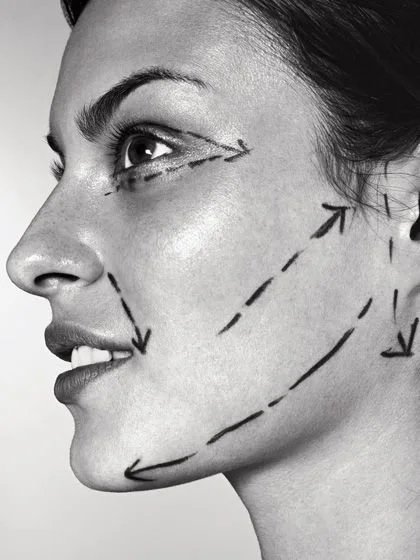
Deep Dive about MedSanctuary. Surgical Experience, Surgeon, Care Program and more.
This blog provides clear, professional guidance for international patients considering plastic surgery in Thailand, highlighting MedSanctuary’s affordable all-inclusive packages, comprehensive post-op care program, and comfortable accommodation options. It explains how procedures can cost up to 70% less than in many patients’ home countries without compromising safety or quality, outlines pre-travel planning and surgical consultation steps, and emphasizes accreditation, experienced surgeons, and personalized recovery support. Practical tips on choosing the right procedure, understanding risks, preparing for travel, and maximizing recovery outcomes are included, alongside patient testimonials and transparent pricing to help readers make informed decisions with confidence.
Med Sanctuary: A Comparative Strategic Analysis for the Australian Market

1. The Medical Tourism Paradigm: A New Standard for Australian Patients
For the Australian patient, the domestic surgical landscape is increasingly defined by a restrictive dichotomy: prohibitive private healthcare costs on one hand, and exhausting public waiting lists on the other. While medical tourism has long been a fallback, the historical "leap of faith" associated with fragmented offshore options often compromises patient safety and outcome quality. Med Sanctuary represents a strategic paradigm shift, moving beyond mere facilitation to an integrated "continuity of care" model. By bridging the gap between world-class Thai surgical expertise and Australian clinical expectations, we ensure that the patient’s journey is defined by the core brand promise: “Expert hand, never on your own.”
The Med Sanctuary Philosophy is anchored by three strategic pillars designed to eliminate surgical uncertainty:
Uncompromising Safety: Every facility within the network is rigorously vetted to meet Australian-standard protocols. Safety is not a variable; it is a non-negotiable baseline supported by international hospital accreditation.
Surgical Artistry: We prioritize board-certified leaders, specifically Dr. Dominic Rushapol, who brings over 25 years of specialized expertise. This ensures results that are medically sound and aesthetically refined.
Seamless Concierge: Our "Never on Your Own" protocol manages the entire logistical architecture—from private medical transfers and nurse-supported recovery suites to 30-meal nutritional plans and long-term aftercare.
These pillars form a protective "sanctuary," removing the psychological and logistical burdens of overseas surgery and replacing the traditional "leap of faith" with a structured, professional medical pathway.
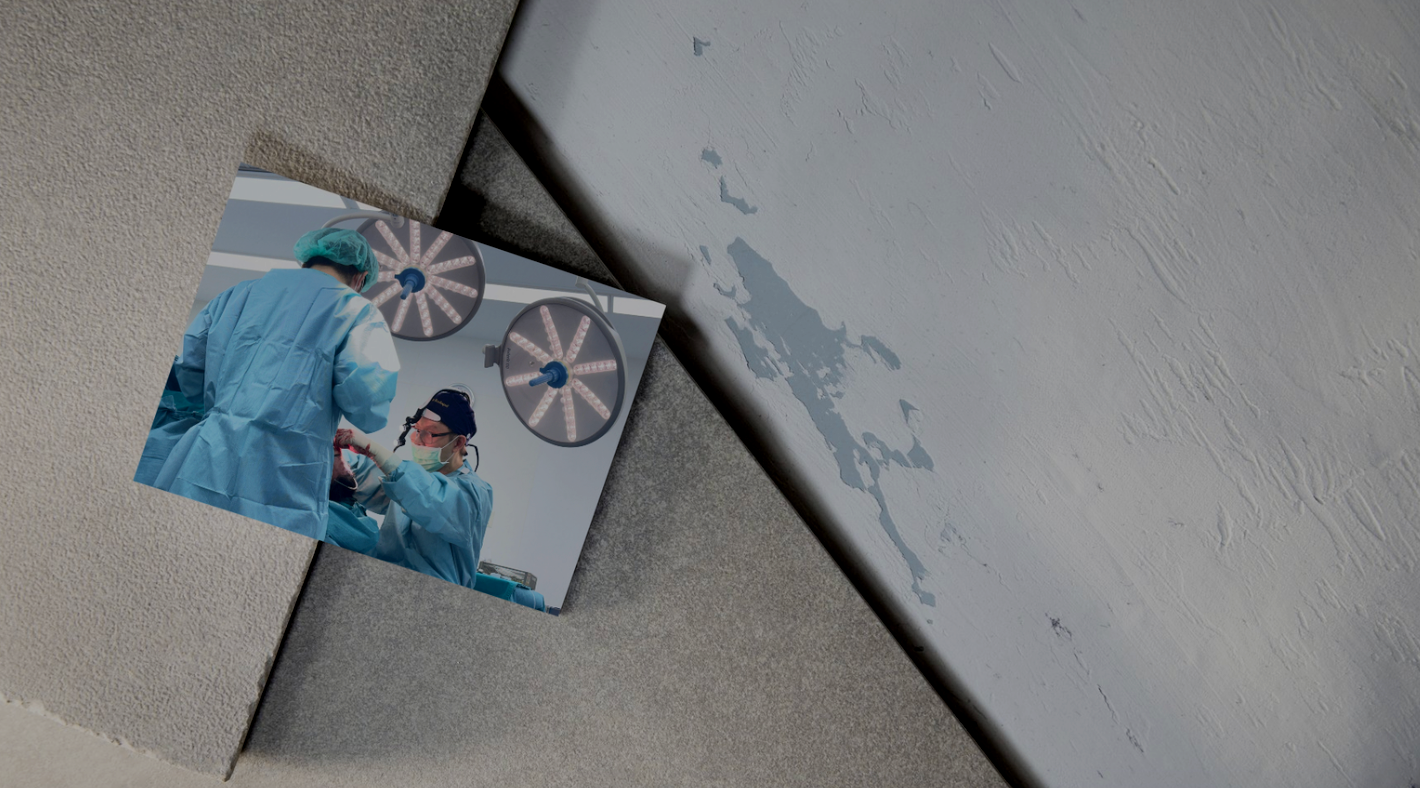
2. Clinical Superiority: The Dr. Dominic Rushapol & Intrarat Synergy
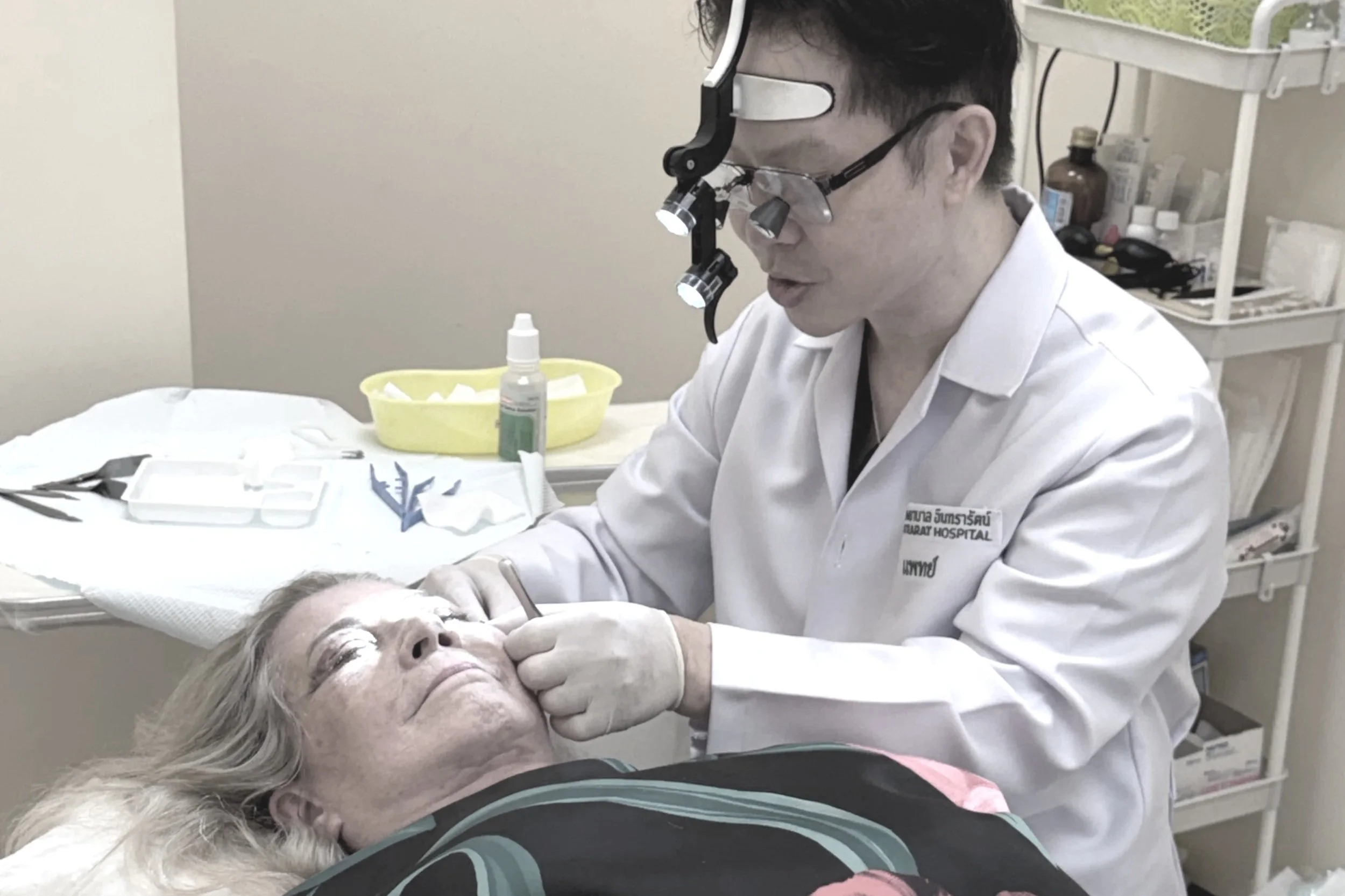
In high-stakes aesthetic surgery, the credentials of the lead surgeon and the technical capacity of the facility are the primary determinants of risk mitigation. Med Sanctuary’s partnership with Dr. Dominic Rushapol and Intrarat Hospital provides a level of clinical synergy rarely found in standard medical tourism.
Surgeon Profile: Dr. Dominic Rushapol

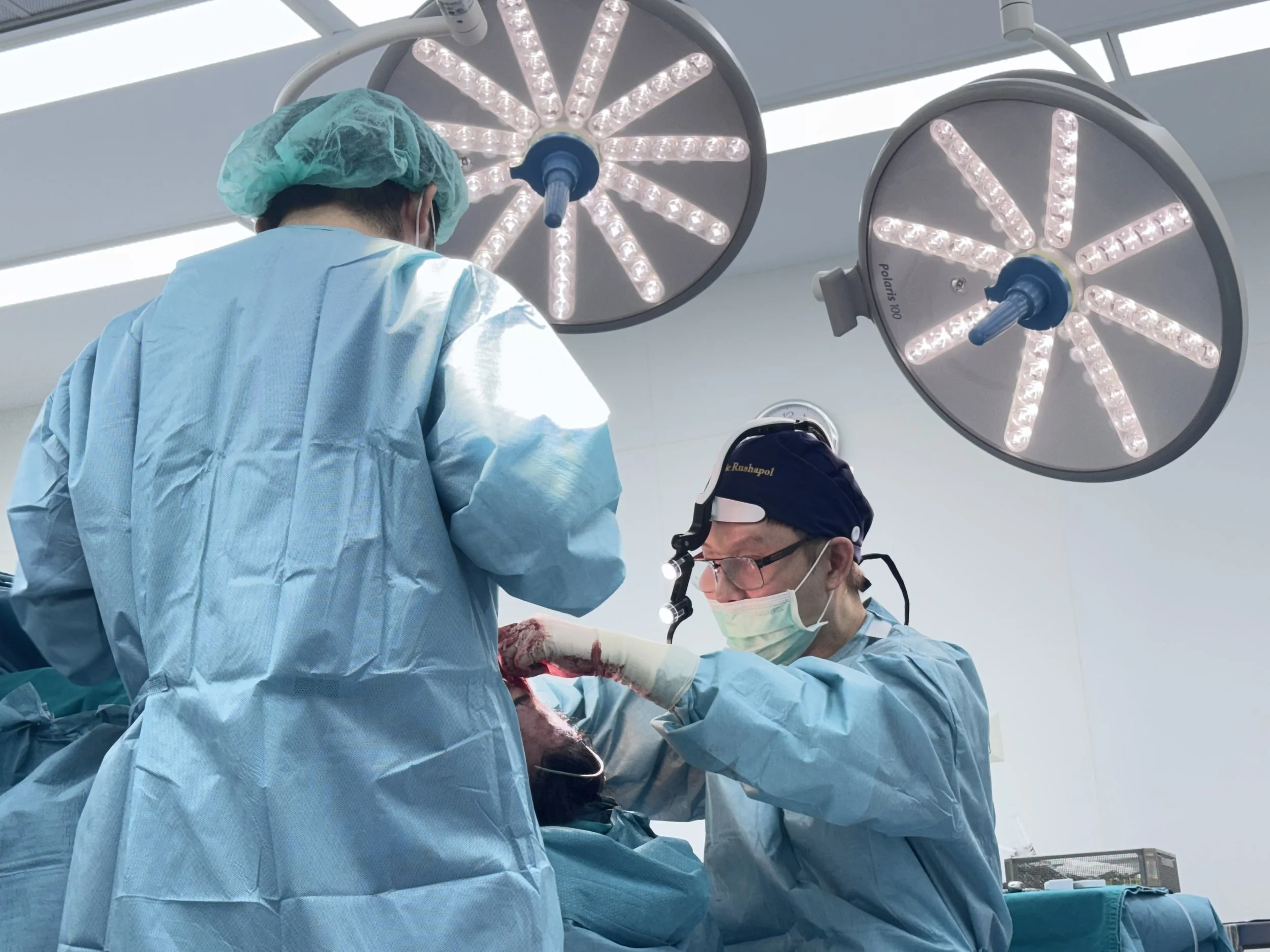
Dr. Dominic Rushapol is a Board-Certified Plastic Surgeon with 28 years of clinical experience. A member of the International Society of Aesthetic Plastic Surgery (ISAPS) since 2008, he is a recognized expert in "Deep Plane" techniques and performs the complete range of plastic surgery, including complex facial rejuvenation and major body contouring. His veteran status ensures that patients receive the highest level of surgical precision.
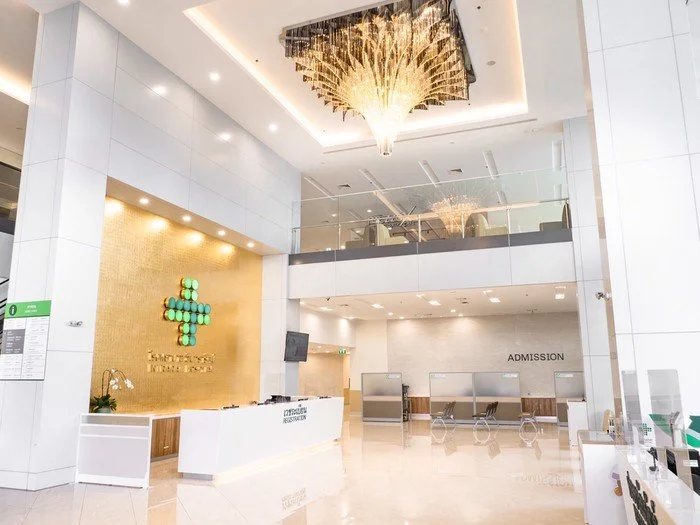
Facility Infrastructure: Intrarat Hospital
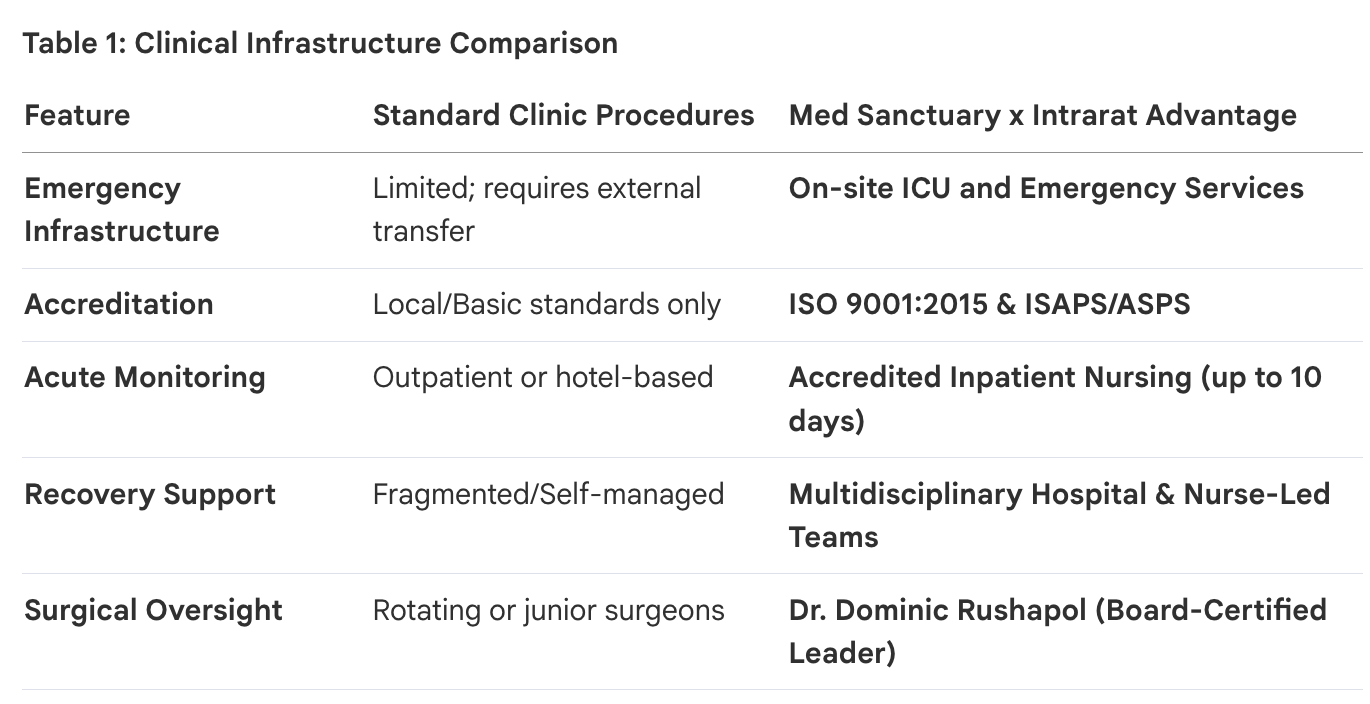
The surgical home for Med Sanctuary is Intrarat Hospital, a facility holding ISO 9001:2015 and ISAPS/ASPS accreditations. Unlike small outpatient clinics, Intrarat provides a full hospital infrastructure, including 24/7 ICU access and multidisciplinary emergency support.
This foundation of clinical safety provides the necessary security to proceed with the logistical and financial components of the journey.
3. Financial Architecture: Transparent Value vs. Domestic Australian Costs
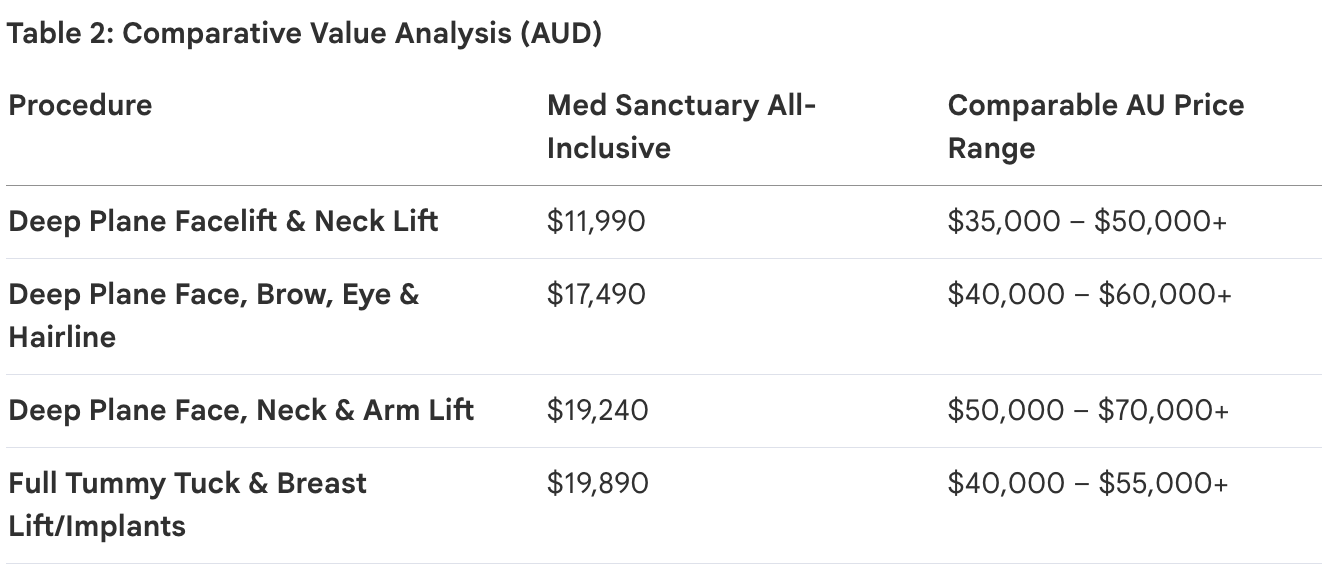
For Australian patients, financial transparency is as vital as clinical safety. Med Sanctuary utilizes a fixed, all-inclusive AUD pricing model that eliminates the volatility of currency fluctuations and the "bill shock" common in Australian private hospitals, where theatre fees, anaesthesia, and pathology are often billed separately.

The "Grand Total All-Inclusive" Definition Med Sanctuary replaces fragmented billing with a comprehensive bundle. For example, a standard facial or body package includes:
Surgical Infrastructure: All surgeon, anaesthetist, and operating room fees.
Acute Care: Pre-operative labs (Blood work, Chest X-Ray, EKG) and ICU ward monitoring.
Integrated Recovery: Hospital inpatient stay (3–10 nights) followed by nurse-supported service apartments.
Concierge & Support: 30 meals, all private medical transfers, and 1-year follow-up.
Recovery Materials: Post-op medications (Antibiotics/Pain relief), wound care sets, and compression garments.
The 70% cost saving realized by patients does not represent a compromise in care; rather, it is the result of a structural advantage within the Thai medical ecosystem, where elite hospital infrastructure and board-certified expertise are available without the extreme overheads of the Australian private sector.
4. The 14-Day Integrated Recovery Ecosystem
The "Acute Post-Op" phase is the clinical gold standard for international surgery. While some body-focused packages are tailored to a 12-day window, Med Sanctuary recommends a 14-day integrated stay to ensure patients are "Fit-to-Fly." The duration of the hospital-based acute phase is determined by procedure complexity: 3–4 days for facial work and up to 10 days for complex body procedures like Belt Lipectomies.
The 14-Day Integrated Timeline:
Day 0: Arrival & Pre-Op: Private airport transfer, hospital check-in, and comprehensive health screening (Blood tests/EKG).
Day 1: Surgery Day: Procedures performed at Intrarat Hospital under general anaesthesia.
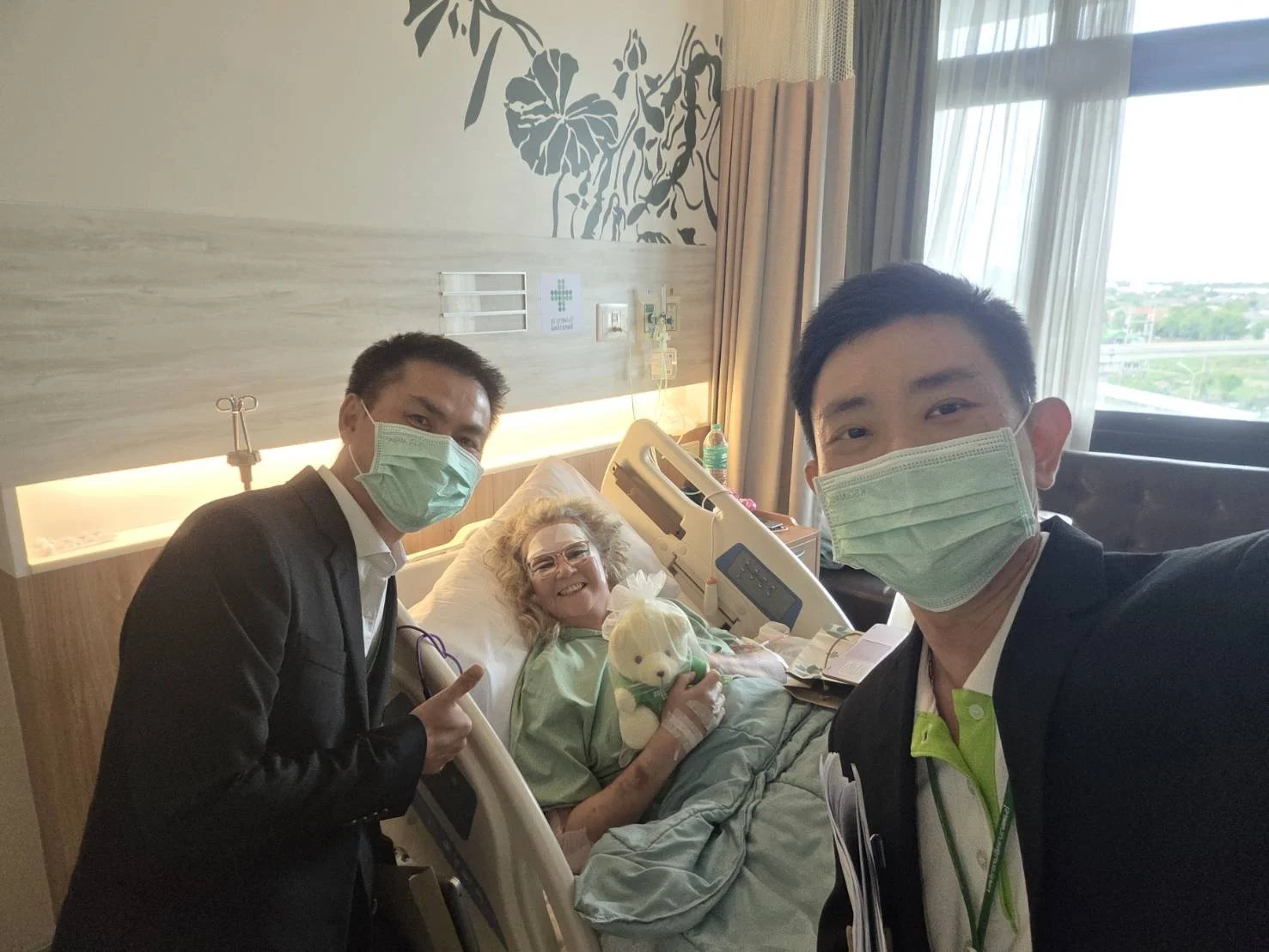
Day 2–10: Acute Phase: Inpatient hospital care. For major body work, this full 10-night stay (as seen in the Nadine protocol) provides 24/7 nursing and drain management.
Day 5–9 (Face/Mid-Body): Transition to nurse-supervised service apartments for those cleared earlier.
Recovery Enhancements: Inclusion of IV Drip sessions (Day 5), Hair Wash services, and Proton/Red Light Therapy to accelerate tissue repair.
Day 12–14: Refinement & Discharge: Suture removal, final review by Dr. Dominic, and provision of the home-going care kit.
Advanced Recovery Modalities:
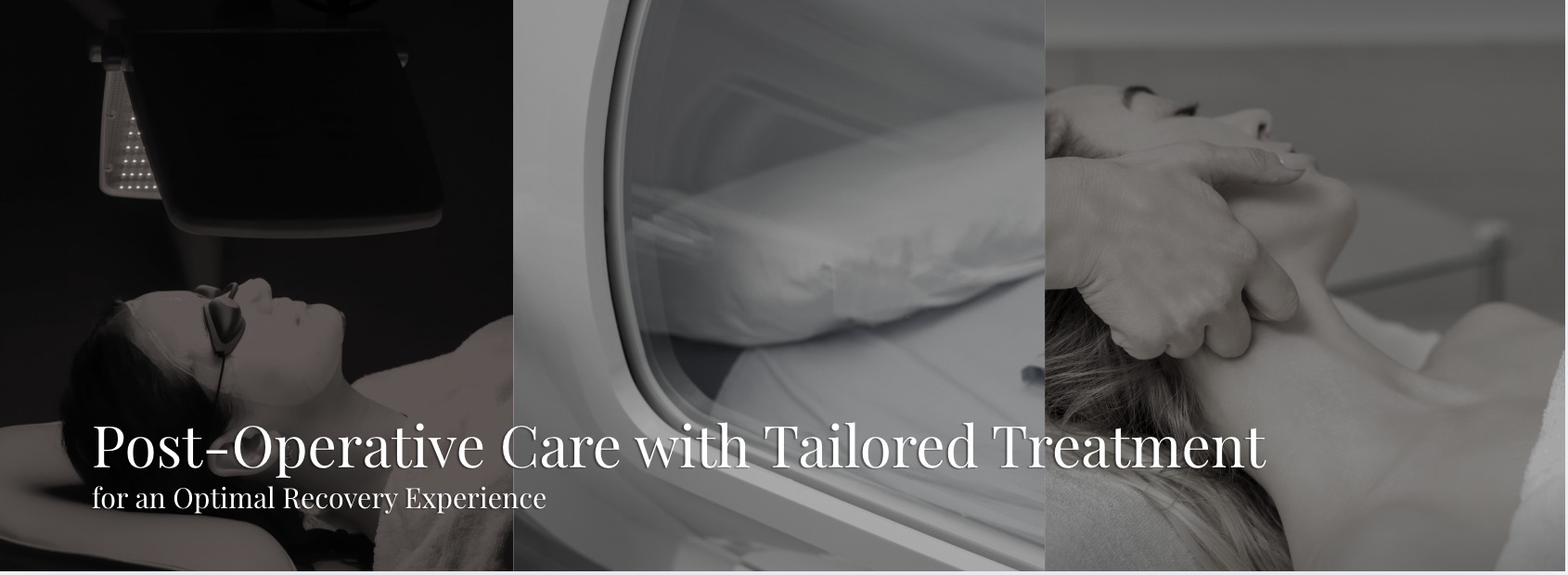
Proton & Red Light Therapy: Used specifically to reduce post-surgical inflammation and stimulate cellular healing.
Lymphatic Recovery: Specialized techniques to manage swelling and improve circulation, reducing overall downtime.
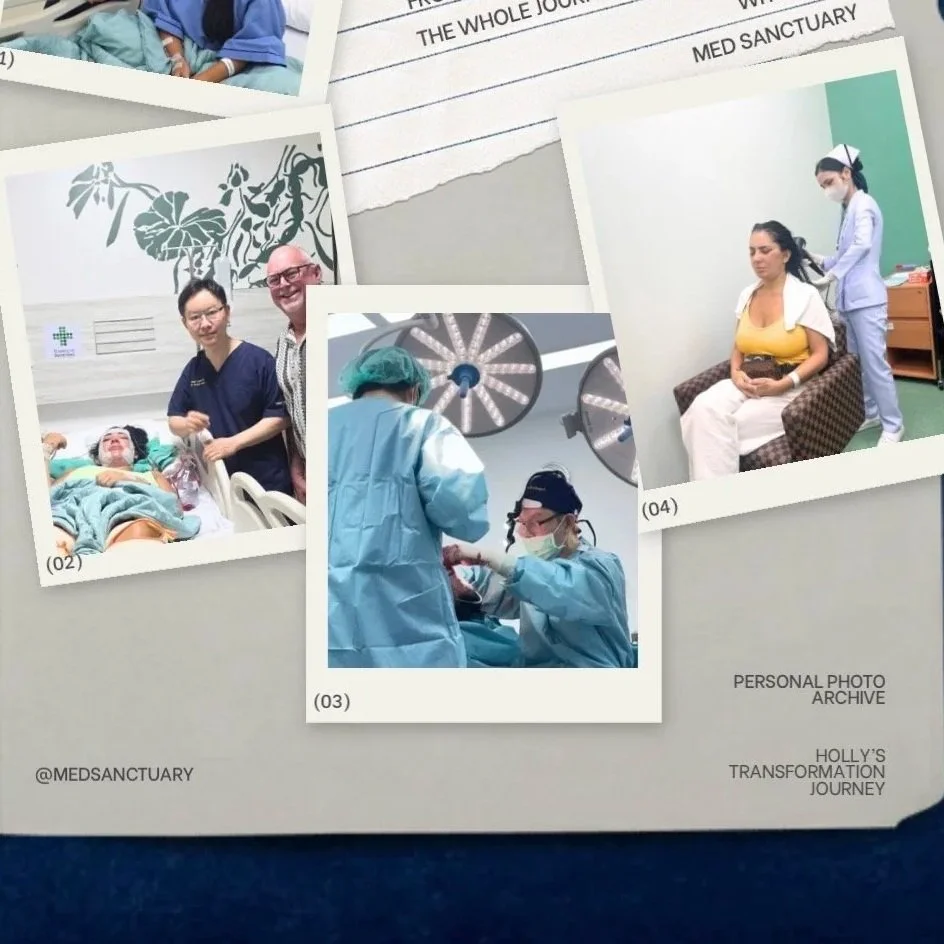
5. Long-Term Risk Mitigation and Australian-Standard Protocols
Med Sanctuary distinguishes itself through a rigorous "Australian-Standard" screening and a transparent revision policy that prioritizes long-term patient advocacy.

The Revision & Aftercare Policy We provide a 1-year follow-up program managed by our medical team. In the rare event of a clinical complication, the "Never on Your Own" policy is clear: Med Sanctuary and Dr. Dominic assume responsibility for all medical, surgical, and post-operative costs. Under these transparent terms, the patient is responsible only for their travel costs and airfares.
Rigorous Pre-Operative Screening To mirror Australian safety standards, patients undergo an intensive screening process to identify potential clinical flags:
GLP-1 Medication Management: Mandatory cessation of medications like Ozempic or Wegovy (frequently used for weight loss or lipoedema) to ensure anaesthetic safety.
Cardiac & Oncology Review: Specific clearance is required for patients with a history of SVT Ablation (cardiac) or Breast Cancer.
Specialized Assessments: Rigorous review for patients with lipoedema or significant weight loss to tailor surgical staging and inpatient durations.
Standardized Labs: Full lipid, liver function, and haematology panels must be cleared by the surgical team before arrival.

Med Sanctuary remains the premier choice for Australians because we treat offshore surgery not as a transaction, but as a high-value clinical journey. By combining the "Expert hand" of Dr. Dominic with a "Never on Your Own" support structure, we provide a safe, world-class alternative to the domestic healthcare gap.

Complete Guide to Tummy Tuck
Abdominoplasty is one of the most requested body-contouring procedures among our Australian and New Zealand patients. This guide explains what it corrects, how it is performed, and what recovery genuinely involves — written with the same candour we bring to every consultation.
Med Sanctuary · Surgical Journeys
The Complete Guide to the Tummy Tuck

Tummy Tuck Introduction
Abdominoplasty is one of the most requested body-contouring procedures among our Australian and New Zealand patients. This guide explains what it corrects, how it is performed, and what recovery genuinely involves — written with the same candour we bring to every consultation.
Written by Med Sanctuary · Bangkok
Introduction
A procedure, not a shortcut.
A tummy tuck — clinically, an abdominoplasty — is a surgical procedure that removes excess skin and fat from the lower abdomen and, where needed, repairs the abdominal muscles beneath. It is frequently sought after pregnancy or significant weight loss, when diet and exercise can no longer resolve what has changed structurally.
It is important to be clear from the outset: this is not a weight-loss method, and it is not a substitute for one. The best outcomes belong to patients at or near a stable, healthy weight who want to address skin and muscle that will not respond to anything else. Below, we walk through the procedure the way we would in person — honestly, and in full.
Part One
What a tummy tuck addresses.
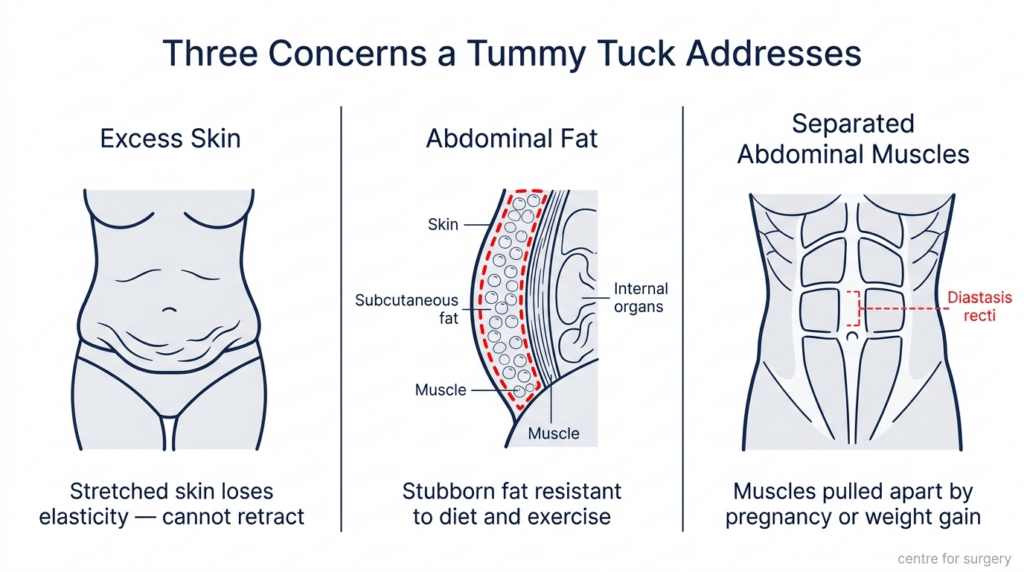
Three distinct concerns sit behind most requests for the procedure. Understanding which ones apply to you is the first step in deciding whether abdominoplasty is the right path.
The three structural concerns abdominoplasty is designed to correct.
Excess skin
After pregnancy or major weight change, stretched skin loses its elasticity and can no longer retract on its own. No amount of training will restore tone to skin that has passed that threshold — only excision will.
Stubborn abdominal fat
A layer of subcutaneous fat that sits resistant to diet and exercise can be addressed during the procedure, often refined further with liposuction of the surrounding zones.
Separated abdominal muscles
Known as diastasis recti, this is the separation of the abdominal muscles — commonly caused by pregnancy or weight gain — that produces a persistent bulge no core work can flatten. A tummy tuck repairs this internal architecture directly, which is what sets it apart from a purely cosmetic skin removal.
Part Two
The types of tummy tuck.
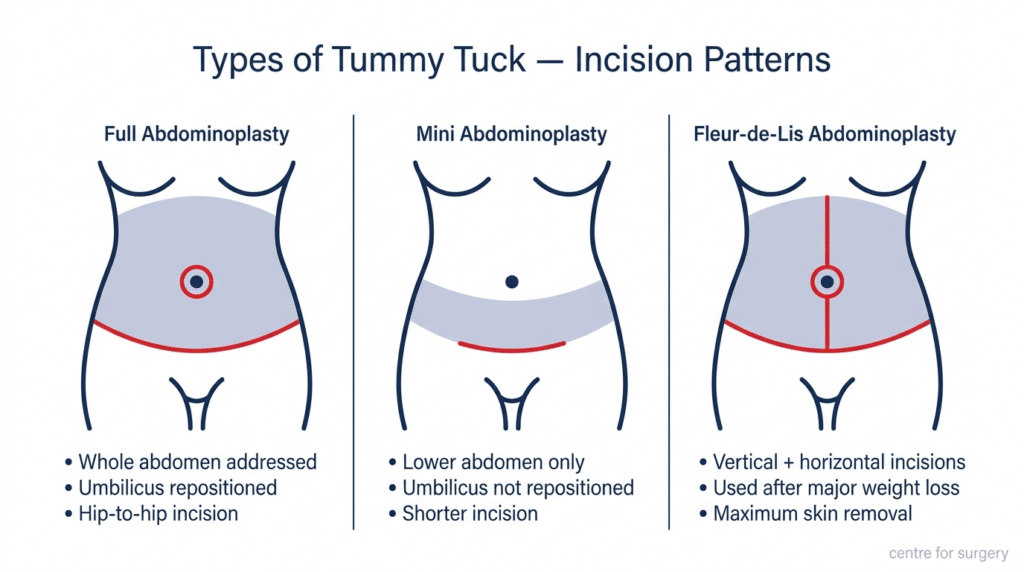
Types of Tummy Tuck
There is no single tummy tuck. The right approach depends on how much skin needs removing and where the laxity sits. Your surgeon selects the incision pattern that achieves the result with the least scarring possible for your anatomy.
The three principal incision patterns, matched to the extent of correction required.
Full abdominoplasty
Addresses the whole abdomen, above and below the navel
The umbilicus is repositioned as the skin is redraped
Uses a hip-to-hip incision, concealed below the underwear line
Mini abdominoplasty
Treats the lower abdomen only — below the navel
The umbilicus is not repositioned
Requires a shorter incision, suited to limited lower laxity
Fleur-de-lis abdominoplasty
Combines a vertical and a horizontal incision
Used most often after major weight loss
Allows maximum skin removal in both directions
Part Three
How the procedure is performed.
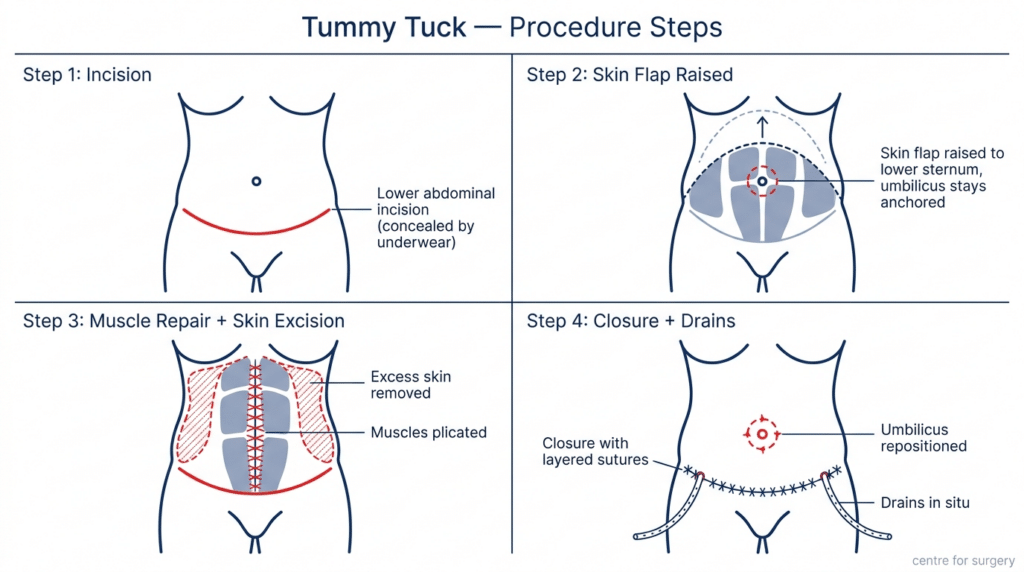
Procedures of Tummy Tuck
Knowing the sequence of a surgery removes much of the fear around it. A full abdominoplasty follows four clear stages, performed under general anaesthetic.
The four operative stages of a full abdominoplasty.
Step 1 — Incision
A lower abdominal incision is made along a line that will sit concealed beneath underwear.
Step 2 — Skin flap raised
The skin is carefully lifted up towards the lower sternum, while the navel stays anchored in its original position.
Step 3 — Muscle repair & skin excision
The separated muscles are stitched back together — plicated — to rebuild a firm abdominal wall, and the excess skin is removed.
Step 4 — Closure & drains
The incision is closed with layered sutures, the navel is brought through to its repositioned site, and temporary drains are placed to prevent fluid collecting as you heal.
The surgery is a single day. The recovery is a season. We plan for both.
Part Four
The recovery timeline.
Recovery from a tummy tuck is longer and more involved than most cosmetic procedures — and we would rather you understood that before you travel than discover it afterwards. The timeline below maps the milestones most patients move through. Individual cases vary.
Seven recovery milestones, from day-case discharge to full scar maturation.
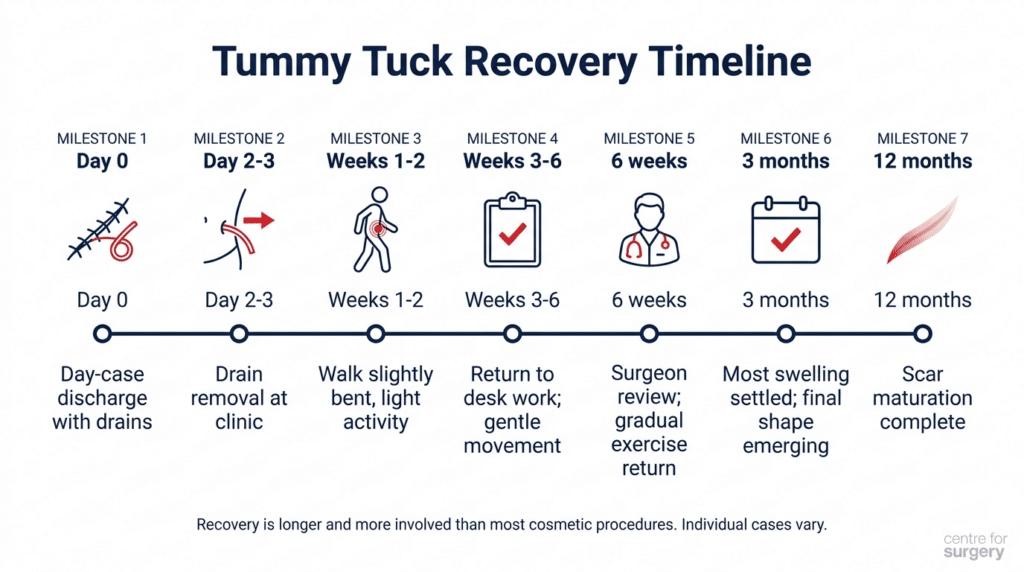
Tummy Tuck Recovery TImeline
Day 0 — Day-case discharge with drains in place.
Day 2–3 — Drain removal at the clinic.
Weeks 1–2 — Walking slightly bent, light activity only.
Weeks 3–6 — Return to desk work and gentle movement.
6 weeks — Surgeon review; gradual return to exercise.
3 months — Most swelling settled; the final shape begins to emerge.
12 months — Scar maturation complete.
Why this matters for travelling patients
For our Australian and New Zealand patients, the early-stage milestones shape how we structure your stay in Bangkok — including the recommended extended recovery period before flying home. We build your journey around this timeline, not against it.
Part Five
Combining procedures.
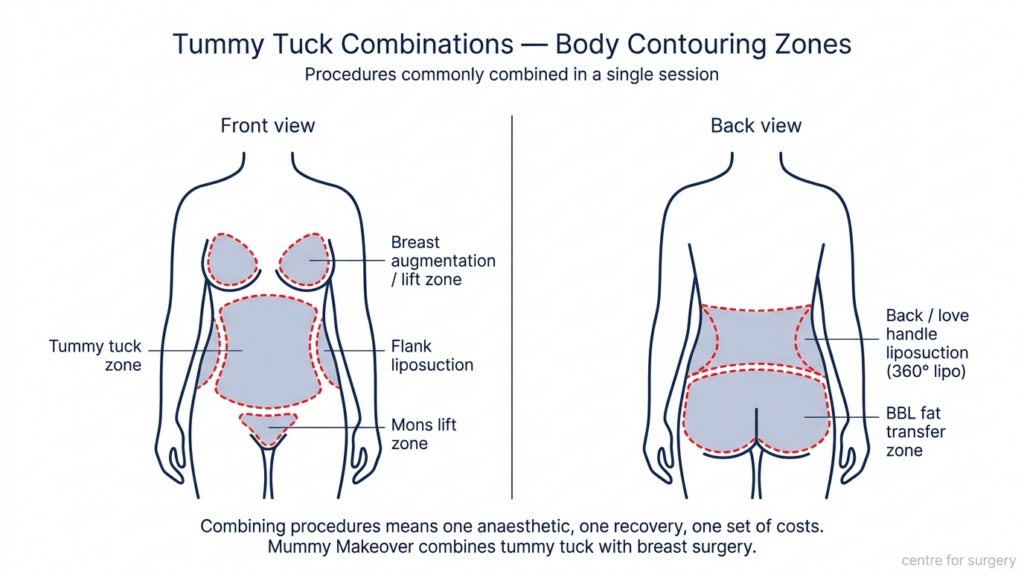
Tummy Tuck Combinations- Body Contouring Zones
A tummy tuck is often performed alongside other body-contouring procedures in a single session. Combining them means one anaesthetic, one recovery, and one set of costs — a meaningful advantage for patients travelling from overseas.
Contouring zones commonly addressed in the same session as abdominoplasty.
Frequently combined zones include flank and 360-degree liposuction, a mons lift, breast augmentation or lift, and fat transfer. When a tummy tuck is paired with breast surgery, the combination is commonly known as a Mummy Makeover — one of our most requested all-inclusive journeys.
Whether combining is right for you depends on your health, the surgeon's assessment, and the total operative time considered safe in one session. This is decided in consultation, never in advance.
In closing
An informed decision is a better one.
A tummy tuck can be genuinely transformative for the right patient — restoring not only contour but the structural integrity of the abdominal wall. It is also real surgery, with a real recovery, and it deserves to be approached with clear eyes. Our role at Med Sanctuary is to give you the full picture, connect you with a board-certified surgeon, and hold the details of your journey so you can focus on healing.
If you are considering abdominoplasty, the next step is a personal assessment — not a sales call. We will review your goals, your medical history, and whether the procedure suits you at all.

Begin with a private consultation
Share your goals and a few photographs, and we will return a candid assessment and an all-inclusive plan tailored to your case.
MED SANCTUARY
Bangkok · Surgical Journeys for Australia & New Zealand
This guide is general educational information and does not constitute medical advice. Surgical suitability, technique, and outcomes vary by individual and can only be determined through consultation with a board-certified surgeon. All procedures carry risk.
