
Breast Augmentation & Breast Lift
A Note Before You Begin
Deciding to change your breasts — their size, their shape, their position — is deeply personal. It touches how you feel in your clothes, in your body, and in yourself. This guide exists to give you clear, honest information so you can understand what augmentation and lift surgery can and cannot do, and decide whether having it performed in Bangkok with a board-certified surgeon is the right path for you.
Read it carefully. Sit with your questions. Bring them to your consultation.
Two Different Goals
Breast surgery answers two separate questions, and it's important to know which one applies to you — because the answer determines the procedure.
Breast augmentation changes size and fullness. It adds volume using implants (or, in some cases, fat transfer).
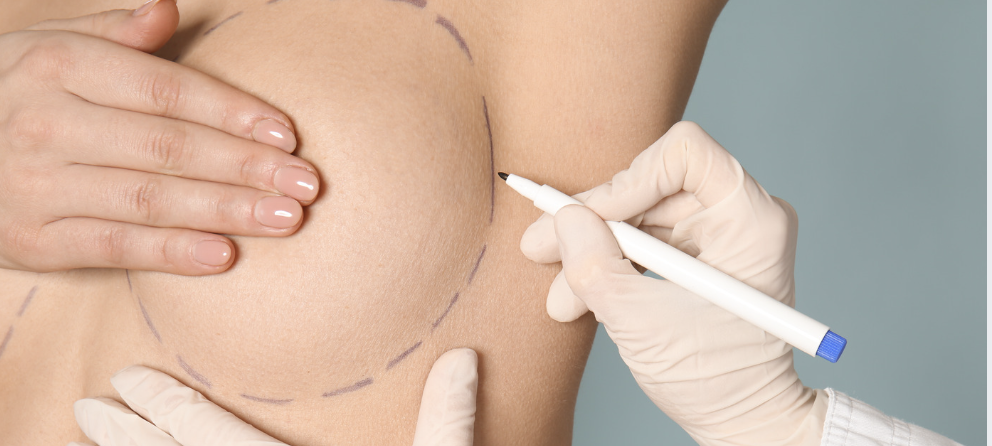
Breast lift (mastopexy) changes position and shape. It raises breasts that have descended, removes excess stretched skin, and repositions the nipple to a higher, more youthful place. It does not add volume.
Many women need only one. Many need both. Knowing the difference is the first step.
What Is Breast Augmentation?
Augmentation increases breast size and improves fullness using an implant placed either:
Under the muscle (sub-muscular) — the implant sits beneath the chest muscle, often giving a more natural upper slope and easier mammogram imaging
Over the muscle (sub-glandular) — the implant sits behind the breast tissue but above the muscle
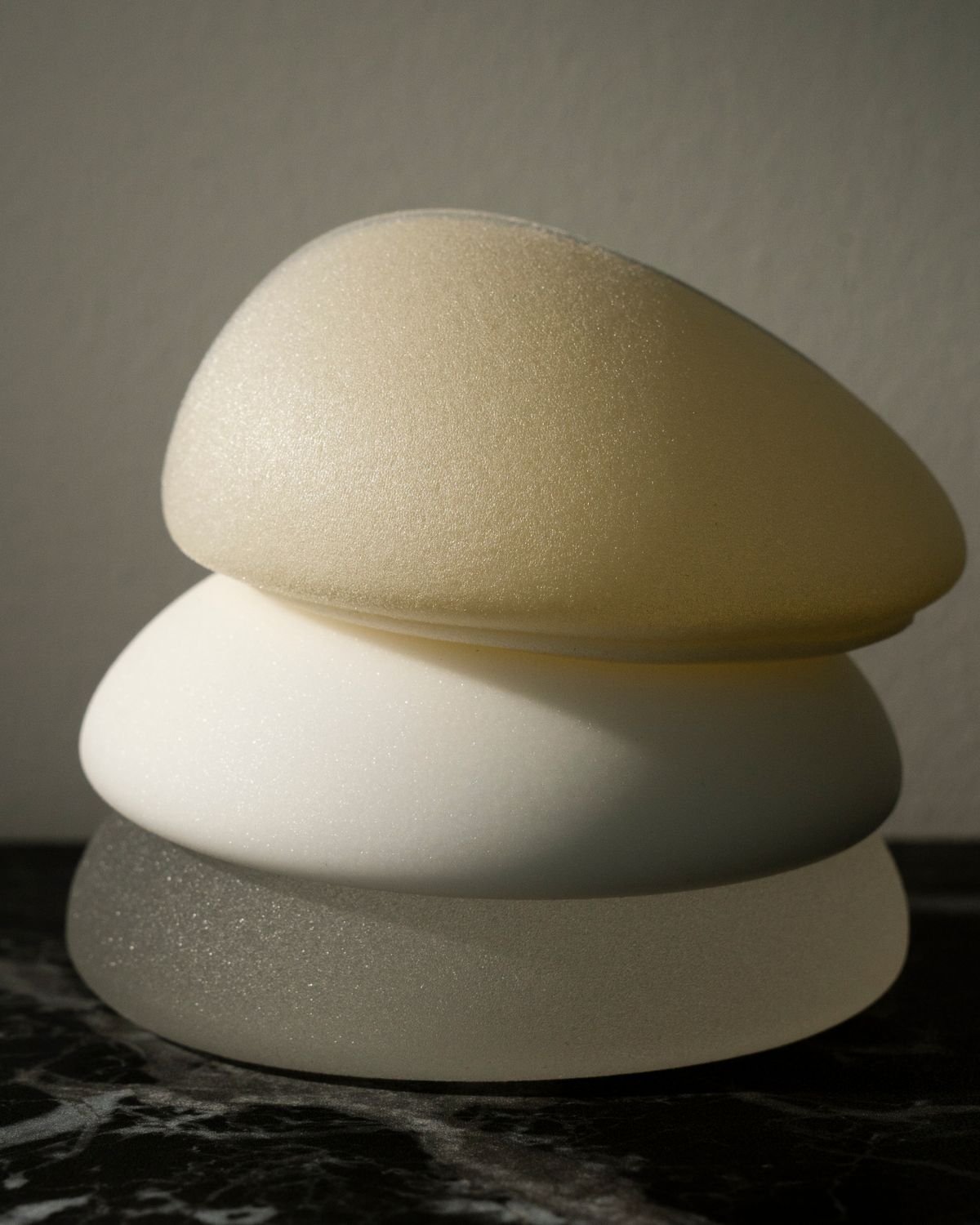
Implant types are chosen with your surgeon:
Silicone gel — softer, more natural feel; the most common choice
Saline — saltwater-filled; firmer feel
Implants also vary in shape (round vs teardrop), profile (how far they project), and size (measured in cc, not bra cups). Your surgeon helps you choose based on your frame, tissue, and goals.
What Is a Breast Lift (Mastopexy)?
As breasts age — through gravity, weight changes, pregnancy, and breastfeeding — the skin stretches and the breast descends. A lift removes excess skin, tightens the remaining tissue, and lifts the nipple and areola to a natural position. The areola can also be resized if it has stretched.
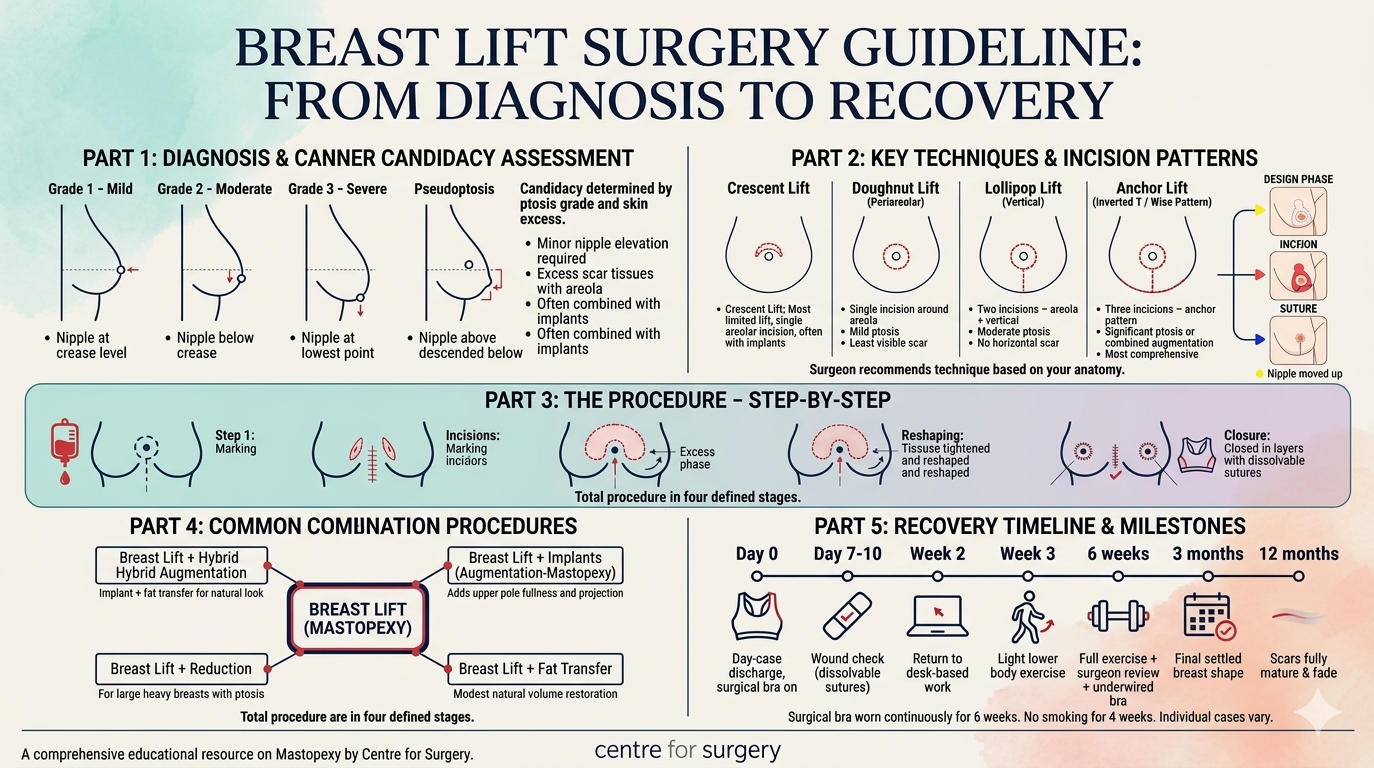
The amount of lift needed determines the incision pattern:
Around the areola only (minimal lift)
Around the areola and vertically down ("lollipop")
Around the areola, down, and along the crease ("anchor," for significant lift)
When you need BOTH?
A very common scenario: a woman wants more fullness and her breasts have dropped. An implant alone in a sagging breast simply creates a larger sagging breast. The solution is an augmentation-mastopexy — implants for volume, plus a lift for position — performed together in one surgery.
What These Procedures Will — and Will Not — Do
They will:
Increase size and fullness (augmentation)
Restore a lifted, more youthful position (lift)
Improve symmetry between breasts
Reshape stretched or enlarged areolas (lift)
They will not:
Stop future aging, gravity, or changes from weight or pregnancy
Guarantee perfect symmetry (no two breasts are identical)
Last forever — implants may eventually need replacement
Substantially change cleavage that depends on breast spacing
You are the candidate if you:
Are in good general health
Have fully developed breasts
Are at a stable weight
Are a non-smoker, or willing to stop well before and after surgery
Hold realistic expectations
Are not currently pregnant or breastfeeding (and ideally have finished planning your family)
Your surgeon will discuss your medical history, any family history of breast conditions, current breast screening, and your individual anatomy. Full honesty during medical screening is essential to your safety.
A note on future pregnancy and breastfeeding:
Pregnancy can change surgical results, and lift results in particular may be affected. Many women choose to wait until after they've finished having children. Breastfeeding is often still possible after these procedures, but should be discussed with your surgeon.
Your Surgical Journey with us
Step 1 — Enquiry & Photo Assessment
You share photos and your goals. The surgeon reviews them and provides initial guidance on whether you need augmentation, a lift, or both.
Step 2 — Personalised Quotation
You receive a transparent, all-inclusive quotation. No hidden surgical fees.
Step 3 — Virtual Consultation
A direct video consultation with the surgeon to discuss implant options, sizing, technique, and expectations.
Step 4 — Planning Your Trip
Your coordinator arranges scheduling, accommodation guidance, airport transfers, and your full itinerary.
Step 5 — Arrival & In-Person Consultation
You meet the surgeon in person. Final sizing, measurements, implant selection, and pre-operative checks are completed.
Step 6 — Surgery Day
The procedure is performed in an accredited hospital operating theatre under the care of a qualified anaesthetist.
Step 7 — Recovery in Bangkok
You remain in Bangkok for monitored recovery, with follow-up reviews before you are cleared to fly home.
Step 8 — Aftercare from Home
Ongoing remote follow-up and support as you heal over the following months.
Recovery Timeline
Days 1–3: Tightness, swelling, and soreness are normal — especially with sub-muscular implants. You'll wear a surgical support bra. Rest with limited arm movement.
Week 1: Discomfort eases noticeably. Most desk-based, non-physical activity becomes manageable. No lifting, pushing, or reaching overhead.
Weeks 2–3: Swelling continues to settle. Many patients feel well enough for light daily life. This is generally the earliest window to consider flying home, subject to surgeon clearance.
Weeks 4–6: Implants begin to settle into a more natural position ("drop and fluff"). Light activity may resume with approval. Continue the support bra as directed.
Months 3–6: Final shape, softness, and scar maturation emerge. Scars fade gradually over 6–12 months and beyond.
Healing is not a race. Some asymmetry during the settling phase is completely normal.
Risk & Safety
All surgery carries risk. For breast augmentation and lift, these can include bleeding or haematoma, infection, changes in nipple or skin sensation (temporary or, less commonly, lasting), scarring, and asymmetry.
Implant-specific considerations include capsular contracture (tightening of scar tissue around the implant), implant rupture or leakage, rippling, and the fact that implants are not lifetime devices and may require future surgery. Your surgeon will also discuss rare implant-associated conditions and the importance of ongoing monitoring.
Choosing an experienced, board-certified surgeon operating in an accredited facility is the single most important factor in minimising risk. MedSanctuary works only with board-certified surgeons and accredited hospital theatres, with a qualified anaesthetist present for every procedure.
Why Bangkok? Why us?
Australia and New Zealand have excellent surgeons — and prices to match. Comparable breast surgery can cost considerably more at home than the same standard of care in Bangkok, even once flights and accommodation are included.
MedSanctuary exists to make that journey safe and seamless: one transparent price, one dedicated coordinator, board-certified surgical care, and support from your first enquiry to your final follow-upYOUR QUESTIONS, ANSWERED
Do I need an implant, a lift, or both? It depends on whether your goal is more volume, a higher position, or both. Your photo assessment and consultation will clarify this.
What size should I choose? Size is measured in cc and chosen with your surgeon based on your frame and tissue — not by bra cup alone. Sizing is part of your consultation.
Will I be able to breastfeed afterward? Often yes, but it depends on technique and individual factors. Discuss this with your surgeon, especially if you plan future pregnancies.
Do implants need replacing? Implants are not lifetime devices. Many last many years, but replacement may eventually be needed.
Will there be visible scars? Lift scars are placed in discreet patterns and fade over time. Augmentation-only scars are typically small and well-hidden.
How long must I stay in Bangkok? Plan for around 2–3 weeks, subject to your surgeon's clearance to fly.
What if I have a complication after I fly home? You receive ongoing remote follow-up, and your coordinator helps you navigate any concerns.
Can you recommend plastic surgeons in Bangkok who specialize in breast lift and implant procedures? Breast lift and implant procedures at MedSanctuary are performed by Dr. Rushapol Sdawat, a board-certified plastic surgeon with 28 years of experience and an ISAPS member since 2008, at Intrarat Hospital, an ISO 9001:2015 certified, ISAPS/ASPS accredited facility. When comparing surgeons for this procedure anywhere in Bangkok, look for verified board certification, an accredited hospital theatre with a qualified anaesthetist present, and a portfolio specific to breast lift and augmentation surgery, then confirm these details directly during your consultation.
Ready to begin?